 sinra
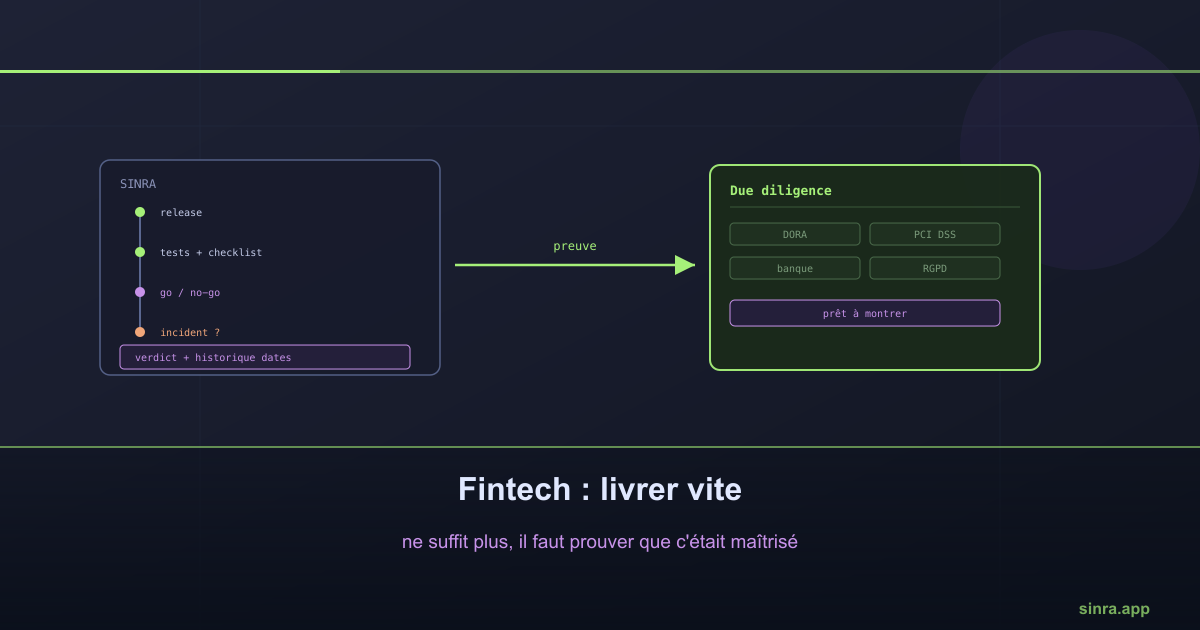
Fintech: shipping fast isn't enough anymore, you have to prove it was controlled
DORA, PCI DSS, banking due diligence: fintechs must now demonstrate, not just claim, how every release was specified, tested, validated, and handled when something went wrong.
A partner bank sends its annual due diligence questionnaire. A major client asks, before signing, how production incidents get handled. A regulator wants to see the decision chain behind a specific release. In each case, the team knows it did things properly: tests ran, the review happened, the incident got resolved. But finding the formalized, dated proof takes days of digging through closed tickets, Slack messages buried in history, and documents that were never updated.
Reassuring partners is no longer just about shipping fast
A fintech runs on the trust it earns from its banking partners, its clients, and its regulators. Shipping fast still matters: competition never slows down. But speed alone no longer cuts it. A partner bank’s due diligence, a major client’s security questionnaire, incident management requirements: sooner or later, every fintech has to show how it handles changes and incidents, not just claim it does so well. A team that can’t produce that proof loses valuable sales time on every cycle, and credibility at every audit.
Scattered evidence, never centralized
Without the right tool, this evidence exists, but nowhere in a usable form. A Jira ticket tells you what was built. A Slack message tells you why a go or no-go decision was made, then disappears into the conversation flow. A shared document lists a release’s validation criteria, but is never updated once signed off. None of these artifacts link to each other: reconstructing the full chain between a feature, its tests, its release validation, and any incident that followed means cross referencing three tools that were never designed to talk to each other.
This debt costs nothing day to day. It costs dearly at the exact moment a partner bank, a client, or a regulator asks for it, with a response window measured in days, not weeks.
The regulatory pressure fintechs face
Fintechs don’t choose to add this rigor, it’s imposed on them by an increasingly demanding regulatory environment:
- DORA (Digital Operational Resilience Act) requires financial institutions, and by extension their technology providers, to rigorously manage IT changes and incidents, with strict notification deadlines.
- PCI DSS governs any organization handling payment data, with precise requirements on change control and access traceability.
- Banking due diligence remains, in practice, the most concrete filter: before a financial institution onboards a fintech as a partner or vendor, it assesses its ability to document its development and incident processes.
- Customer security questionnaires, increasingly standardized, ask for the same proof in a different form: who validated what, when, and with what consequences in case of a problem.
None of these frameworks mandates a specific tool. All of them demand, in substance, the same thing: the ability to reconstruct, without effort, the chain between a release decision and its consequences.
What Sinra brings to this equation
Sinra is not a certification and does not by itself guarantee compliance with a regulation like DORA or PCI DSS. What it does: structure and document development and incident management processes, so the proof already exists when it’s requested.
- Controlled releases. Every release groups its features, its tests, and its go live checklist in one place, from the start.
- Traceable go / no-go decisions. Evaluation criteria, verdict, and history for every validation step, replacing the Slack message that disappears with a decision that stays reviewable years later.
- Structured incident management. Blameless postmortems, remediation actions tracked to resolution, resolution time calculated automatically: incident management becomes proof of control in itself, not a blind spot.
- A usable history. Planning decisions, validations, and incidents stay linked to the relevant cycles and releases, forming a reconstructible chain without manual digging.
- Hosted in France, GDPR. All data is stored on European servers, in France, with no dependency on non European cloud hyperscalers.
The takeaway
The trust a fintech earns from its banking partners, clients, and regulators isn’t declared, it’s documented, decision by decision. Teams that rebuild this documentation on demand, across tickets, messages, and scattered files, pay for it in response time and credibility. By linking releases, validations, and incidents in a single system from day one, Sinra turns that race against the clock into a history already ready to be shown.
Ready to Transform Your Project Management?
Apply these insights with Sinra - the unified platform for modern teams.
Start Free Trial