 sinra
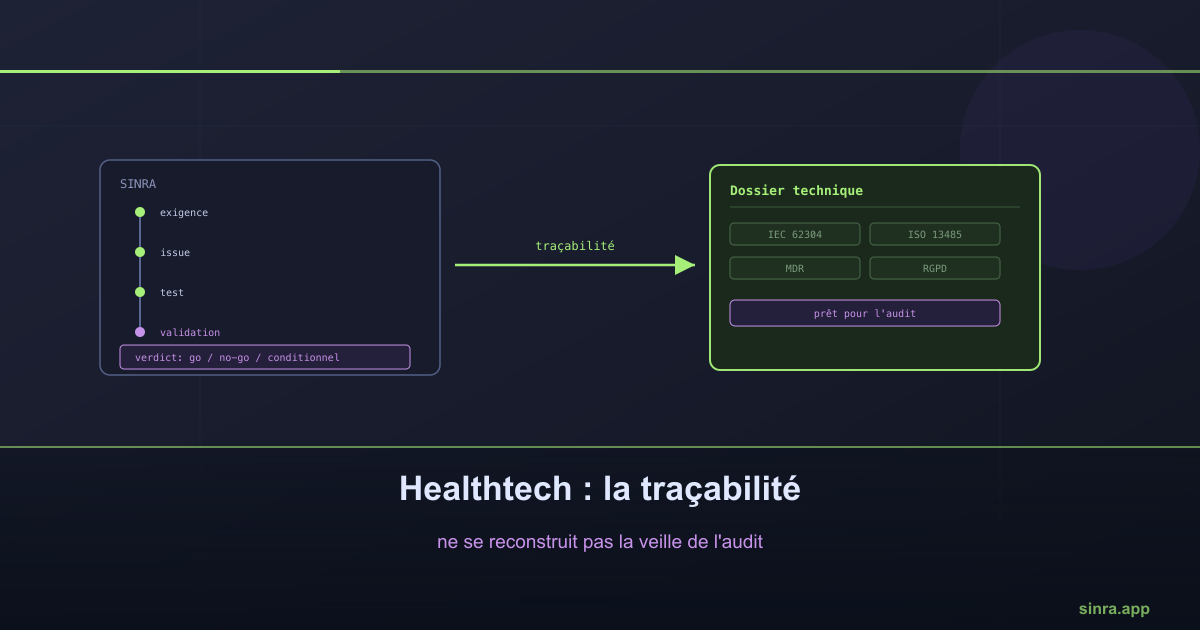
Healthtech: software traceability can't be rebuilt the night before the audit
IEC 62304, ISO 13485, MDR: healthtech startups build with tools made for speed, then discover they must prove, requirement by requirement, how every line of code was specified, verified, and validated.
An auditor asks how a specific requirement was implemented, then verified, then validated before release. The team knows it was done: the product works, the tests pass, nobody doubts the outcome. But proving the full path, requirement by requirement, takes three days of manual reconstruction across Jira, an Excel spreadsheet, and scattered Word reports. In healthcare, this scene repeats at every audit, every funding round, every quality review.
Working software isn’t enough
Outside healthcare, software that works is software that succeeded. In healthtech and medtech, that’s never enough: you also have to demonstrate how it was specified, built, verified, and validated. The difference looks subtle. It isn’t. An auditor doesn’t ask whether a feature works, they ask to see the chain of evidence: which requirement, which issues implemented it, which tests verified it, which review validated the result before release. Without a reconstructible chain, even the best engineered software remains, from a regulatory standpoint, non compliant.
Three tools, zero links between them
Most young healthtech teams inherit a toolchain built for speed, not for proof: Jira or Linear to track development, an Excel spreadsheet for the traceability matrix, Word documents for validation minutes. Each does its own job in isolation. None of the three knows what the other two are doing. The link between a requirement and the issue that implements it, between that issue and the test that verifies it, between that test and the decision that validated the release, exists nowhere in any system. It exists only in the team’s memory, and in the hours spent reconstructing it before every audit.
This traceability debt is invisible day to day. It gets paid all at once, at the worst possible time: during an ISO 13485 audit, an MDR technical file review, or an investor due diligence process that asks for proof of rigor before signing.
The regulatory pressure healthtech teams face
Healthtech and medtech startups don’t choose to add rigor, they absorb it from the outside, in several layers that stack on top of each other:
- IEC 62304 governs the medical device software lifecycle: risk classification, planning, requirements, architecture, implementation, integration testing, system testing. Each step must be documented and linked to the one before it.
- ISO 13485 requires a quality management system covering the entire product lifecycle, not just development: design, production, post market surveillance, incident management.
- MDR (Medical Device Regulation) in Europe, and the equivalent FDA requirements in the US, demand a technical file demonstrating compliance, with full traceability between user requirements, specifications, verification, and validation.
- GDPR and data hosting add another layer as soon as the product touches health data, even indirectly, with location and encryption expectations that go beyond software itself.
None of these standards mandates a specific tool. All of them demand, in substance, the same thing: the ability to reconstruct, without relying on collective memory, the full path from a requirement to its verified release.
What Sinra brings to this equation
Sinra doesn’t certify anything and doesn’t replace any quality process: Sinra is a development organization tool, not a certification, and does not by itself guarantee compliance with a standard like IEC 62304 or ISO 13485. What it does: build traceability while the team develops, so it never needs to be reconstructed after the fact.
- Requirements linked to code and tests. Every specification is linked to the issues that implement it and the tests that verify it. The link that Jira, Excel, and Word couldn’t maintain now exists natively, in a single system.
- Formal, logged validations. Phase reviews with explicit evaluation criteria, a go / no-go / conditional verdict, and a full history of every decision: exactly what an auditor asks to see, already available instead of reconstructed.
- Documented incidents. Structured postmortems: timeline, systemic factors, remediation actions, resolution time. Incident management becomes a proof of quality maturity in itself, not a blind spot.
- A shared vocabulary. A business glossary shared and reused across specifications, so a requirement means the same thing to the developer who implements it and the auditor who reviews it a year later.
- The rigor of the V-model, the pace of agile. Specs follow their own writing and validation flow while developers move in short cycles. Tests and phase reviews ensure nothing ships without being verified, without sacrificing the iteration speed a startup can’t afford to lose.
- Hosted in France, GDPR, encrypted data. Sinra is built for development data, not patient data: as in a test environment, only fictional or anonymized data belongs in issues and attachments.
The takeaway
Regulatory traceability in healthtech isn’t a document you write once, before the audit: it’s a discipline built issue by issue, test by test, review by review. Teams that reconstruct it by hand across three disconnected tools pay for it in lost days and stress at every deadline. By linking requirements, development, tests, and validations in a single system from day one, Sinra turns that emergency reconstruction into a history already ready to be shown.
Ready to Transform Your Project Management?
Apply these insights with Sinra - the unified platform for modern teams.
Start Free Trial