 sinra
sinra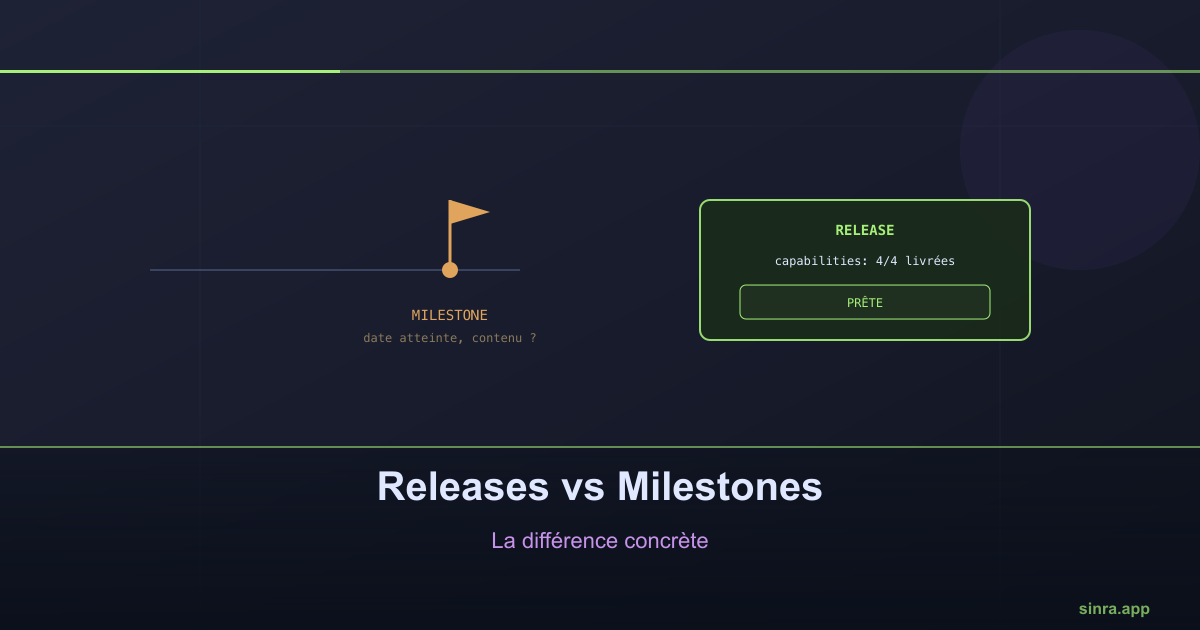
Releases vs Milestones: the Concrete Difference
A milestone marks a date on a timeline. A release commits to precise content, delivered, validated. The difference looks subtle; it changes everything that follows.
Many project management tools use the word milestone to describe what, in software development practice, should be called a release. The two terms are not interchangeable, and confusing them has concrete consequences for how a team tracks what actually ships to production.
What a milestone is
A milestone, in its most common sense, is a time marker on a project timeline. It marks a date: “end of design phase”, “beta launch”, “end of quarter”. A milestone is reached when the date arrives, regardless of what was actually accomplished by that date.
This time-based nature is useful for communicating a schedule, but it has a structural weakness: a milestone can be “reached” without the content planned for that date being actually complete. The date passes, the milestone gets checked off, and the actual content gets negotiated separately.
What a release is
A release, in Sinra’s structure, does not work that way. A release groups a set of predefined capabilities, and its state depends directly on the state of those capabilities. A release is not “reached” on a date: it is ready or not ready, depending on whether its defined content is actually delivered and validated.
This structural difference changes the meaning of the question being asked. With a milestone, the question is “are we on schedule”. With a release, the question is “is the planned content actually there”. These are two different questions, and the second is the one that actually matters when deciding whether something can ship to production.
Why this confusion is costly
An organization that tracks its development with milestones rather than releases risks confusing calendar progress with content progress. A “version 3 launch” milestone hit on schedule, but with half the planned capabilities incomplete, gives a false sense of control. The date is reassuring, the actual content remains uncertain.
This confusion is particularly costly at the end of a project, when calendar pressure pushes teams to declare a milestone reached despite incomplete content, simply because the date is a more visible and easier criterion to check off than the actual state of the work.
Using both, in their rightful place
Milestones still have real value for communicating a schedule to stakeholders who need time-based reference points: “we’re targeting this release for this period”. But they should never replace tracking actual content. A release with its capabilities and its binary completion state remains the source of truth for what is actually ready. The milestone stays a communication marker, not a decision criterion.
The question to ask
Facing a project dashboard, the question to ask is not “are we on schedule” but “what is actually delivered and validated as of today”. If answering that second question requires digging through several sources rather than reading it directly from a release’s state, that is a sign the tracking still confuses calendar and content.
Ready to Transform Your Project Management?
Apply these insights with Sinra - the unified platform for modern teams.
Start Free Trial