 sinra
sinra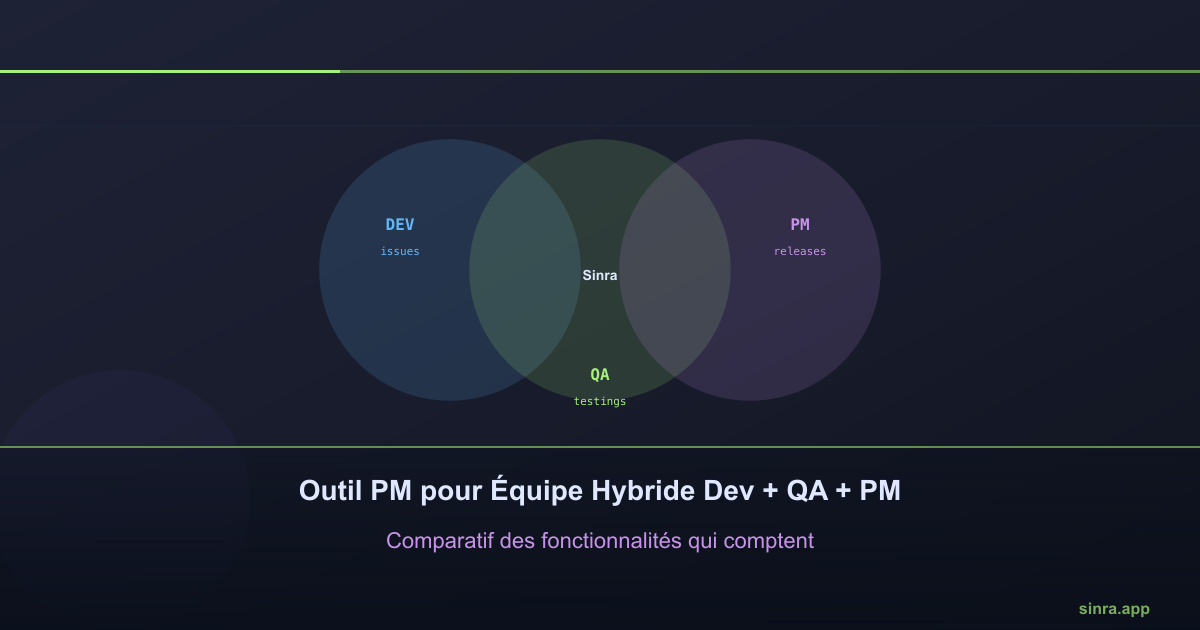
PM Tool for a Hybrid Dev + QA + PM Team: Feature Comparison
A tool built only for developers forgets QA. A tool built for PMs forgets the technical side. A hybrid team needs both, equally.
Most project management tools are designed with one role in mind first, then add the others as secondary extensions. A developer-first tool treats QA as just another ticket type. A PM-first tool treats technical detail as an optional field. A hybrid team feels this imbalance every day.
What a developer needs
A developer works with issues, wants to see dependencies between them before starting, and needs the link between their code and the tracked work to be direct, not an extra manual step. A tool that treats dependencies as free text rather than a structured relationship loses that clarity as soon as the project grows.
What QA needs
A QA person needs testings to be first-class objects, directly linked to the capabilities they validate, with an execution and freshness state viewable without manual reconstruction. In a tool that only treats QA as a generic ticket type, that information gets lost or ends up in a separate spreadsheet, recreating exactly the dispersion a unified tool should eliminate.
What a PM needs
A product manager needs a clear release view of what is shipping, a project view for the multi-quarter roadmap, and the ability to communicate both levels to non-technical stakeholders without translating the tool’s jargon. A tool too focused on the technical ticket makes that communication hard, because the information exists but not at the right level of abstraction.
The real test for a hybrid-team tool
The most reliable test to evaluate a tool on this criterion: have a developer, a QA person and a PM each use the tool for a week, working on their own part, then ask each of them whether they had to step outside the tool to do their job properly. If any one of the three says yes, the tool is not truly built for the hybrid team, even if it works well for the other two.
How Sinra addresses this triple need
Sinra treats issues, testings, releases and projects as native first-class objects, not variants of one another. A developer sees their issues and dependencies directly. A QA person manages their testings linked to capabilities without an external spreadsheet. A PM reviews their releases and projects with a level of detail suited to external communication. All three roles work on the same data, each with the view that matches their actual need, none treated as a secondary case.
What to take away
A project management tool for a hybrid team should not be judged by its most visible demo feature. It should be judged by the absence of compromise for each role involved. If any one role has to consistently step outside the tool to do its job properly, the tool has only solved the problem for part of the team.
Ready to Transform Your Project Management?
Apply these insights with Sinra - the unified platform for modern teams.
Start Free Trial