 sinra
sinra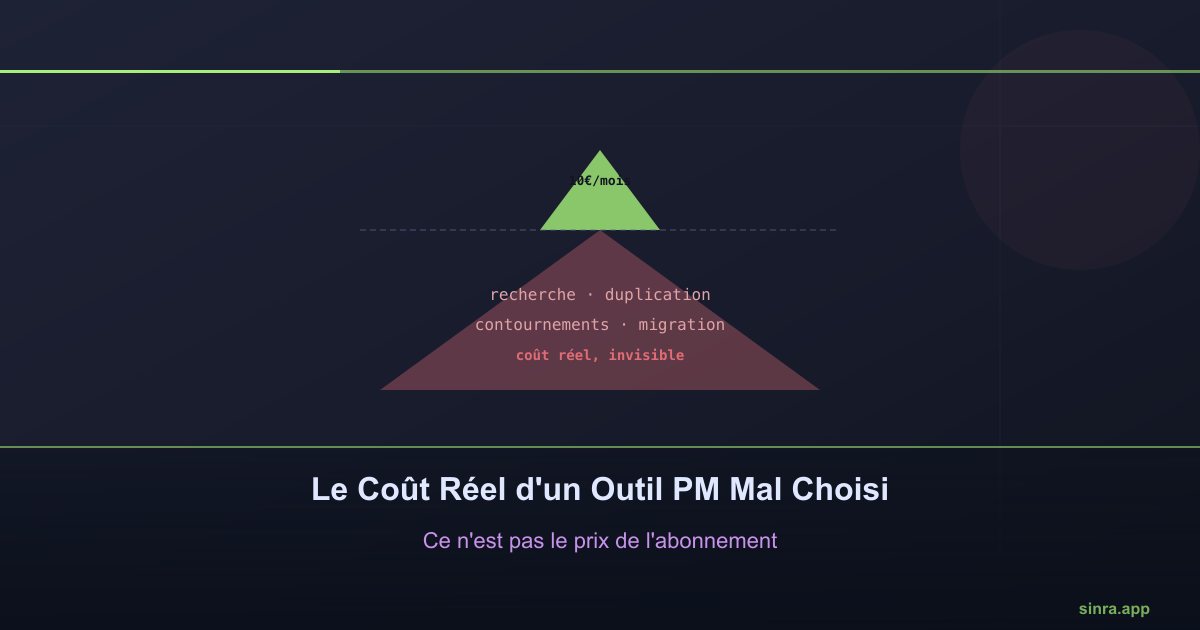
The True Cost of a Poorly Chosen Project Management Tool
The monthly subscription is never the real cost. The real cost is the time each person loses every week working around the tool's limits.
When an organization evaluates a project management tool, the most visible criterion is almost always the subscription price. It is also, often, the least representative of the real cost. The true cost of a poorly fitted tool gets paid elsewhere, diffusely, and rarely measured.
The cost of searching for information
In a team juggling several tools because none of them cover its full need, every person spends part of their week looking for information that exists, but in the wrong system. That time shows up on no dashboard, but it is real: a few minutes here, a quarter hour there, adding up across the whole team over a whole year.
The cost of duplication
A poorly fitted tool pushes toward duplicating information: a spec in a documentation tool, a summary copy-pasted into the tracking ticket, a status copy-pasted into a separate reporting table for management. Every duplication is a potential point of desync, and every inconsistency fix is time not invested in actual work.
The cost of resistance to change
A poorly fitted tool produces, over time, individual workarounds: someone keeps their own parallel list because the official tool does not meet their need, someone else prefers Slack to track certain decisions rather than the tracking tool. These workarounds are individually rational, but they fragment collective information, which is exactly what the tool was supposed to prevent.
The latest cost: the decision to migrate
The highest cost is often paid late, when the organization realizes the tool no longer keeps up with its growth and decides to migrate. By that point, the accumulated history, the habits formed, and the number of people to re-onboard make the migration far more costly than it would have been two years earlier. This deferred cost is rarely anticipated at the time of the initial choice.
How to evaluate this cost before choosing
Rather than comparing only subscription prices, a more honest evaluation asks a different question: over a typical week, how much time does the team spend doing things the tool should be doing for it, like linking a spec to its ticket, knowing whether a release is ready, or finding the state of a test. That time, multiplied by the number of people involved and the average hourly cost, gives an estimate much closer to the real cost than the price shown on the pricing page.
What it changes in the choice
A tool that is slightly more expensive to subscribe to, but eliminates duplication and information searching, often costs less overall than a free or cheap tool that multiplies these invisible frictions. The right question is never “how much does the tool cost”, but “how much does the work the tool does not do for us cost”.
Ready to Transform Your Project Management?
Apply these insights with Sinra - the unified platform for modern teams.
Start Free Trial