 sinra
sinra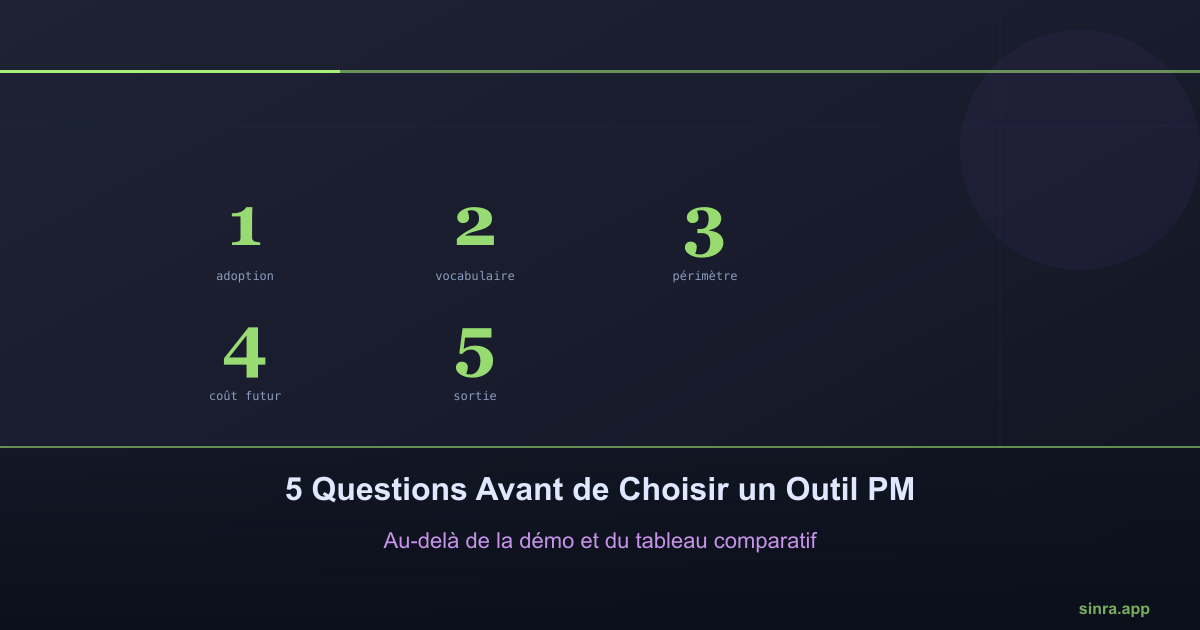
5 Questions to Ask Before Choosing a Project Management Tool
A well-prepared demo always shows a tool at its best. These five questions help you see past the demo, before committing for several years.
Choosing a project management tool is a decision with a high cost of reversal: data migration, collective relearning, resistance to change. A feature list is not enough to evaluate that cost in advance. Here are five more revealing questions than a comparison table.
1. How long before the whole team uses it without help?
A demo shows an expert user who already knows every shortcut. The real question is: how long does it take someone discovering the tool to create, without assistance, a first properly structured piece of work? If the answer involves formal training or lengthy documentation, the tool imposes an entry cost that repeats with every new hire.
2. Does the vocabulary match how the team already talks about its work?
A tool that imposes its own vocabulary (epic, story point, sprint) forces the team to constantly translate between what it naturally says and what the tool displays. A tool whose vocabulary is already concrete and close to the team’s everyday language (issue, capability, release, cycle) removes that translation friction entirely.
3. What happens when the work goes beyond the default scope?
Many tools are designed for a single type of work: only development tickets, only generic task management. The question to ask: when the team also needs to track a release, document a decision, or manage QA, does it need to add another tool, or does the current one already cover that need natively?
4. How much does the tool actually cost at my team’s size in two years?
The price shown for the current team is not the right indicator. The relevant question is about the pricing structure as the team grows: some tools apply tiers that become disproportionate past a certain number of users, or charge separately for features that seemed included at first.
5. What happens the day you want to leave?
A question rarely asked before signing, and yet decisive: can the data be exported easily, in a reusable format, without depending on the vendor’s goodwill? A tool that makes leaving hard does not need to be excellent to be chosen again the following year: it just needs to make switching more costly than the accumulated frustration.
What these questions have in common
None of these five questions appears in a typical feature comparison table. They are all about what happens after signing, not what shows up during the demo. That is exactly what makes them useful: a demo is optimized to convince, daily use over several years is not.
Asking these questions before choosing, including for a tool like Sinra, lets you compare what actually matters instead of what shows up first.
Ready to Transform Your Project Management?
Apply these insights with Sinra - the unified platform for modern teams.
Start Free Trial