 sinra
sinra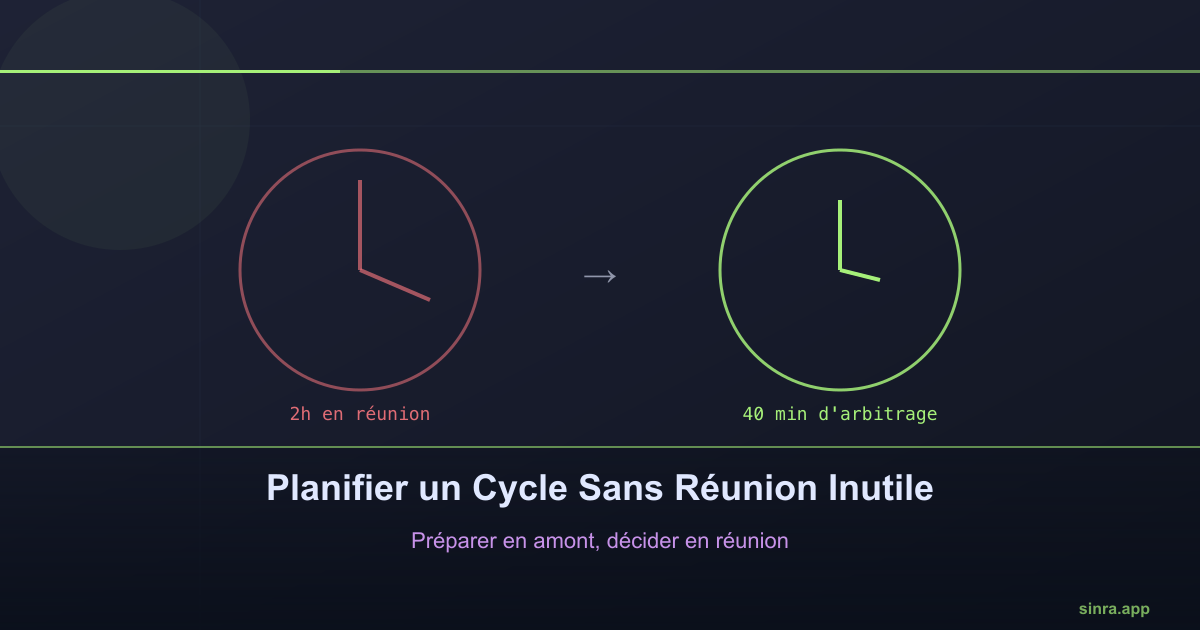
How to Plan a 2-Week Cycle Without a Wasted Meeting
A two-hour planning meeting to decide the content of two weeks of work: the ratio is rarely good. Here is how to cut it down without losing clarity.
The cycle planning meeting has a well-earned reputation for being long, sometimes tedious, and rarely as productive as its duration would suggest. The problem is almost never the meeting itself: it is what teams try to do in it at the same time.
What the planning meeting tries to do all at once
In many teams, the planning meeting bundles three different activities: discovering candidate content for the cycle, discussing and clarifying each item individually, and finally deciding what actually goes into the cycle. Doing these three things at once, with everyone present, explains the excessive length.
Discovery and clarification do not need the whole team present at the same time. Only the final tradeoff really does.
Separating preparation from decision
Upfront preparation means making sure every candidate capability for the cycle already has a clear completion criterion, that open questions have been asked and answered asynchronously, and that dependencies between items have already been identified. This preparation can happen in a distributed way in the days before the meeting, with everyone contributing on what they know, without blocking a shared time slot.
When this preparation is done seriously, the meeting itself has only one role left: arbitrating between ready capabilities, based on team capacity and the priorities of the current release. That arbitration takes thirty to forty-five minutes, not two hours, because there is no discovery left to do live.
What makes this separation possible in the tool
This separation only works if the tracking tool allows asynchronous preparation without losing information. In Sinra, a capability can receive comments, clarifications and a readiness state before it even enters a cycle. Dependencies between issues are visible directly in the interface, not discovered in the meeting when someone suddenly remembers a blocker.
The role of the cycle itself stays precise: a work period with content defined in advance. Its composition can be prepared before the meeting starts, with the meeting only used to validate and settle the last capacity tradeoffs.
The short format, concretely
An effective cycle planning meeting usually follows this outline: a quick reminder of team capacity for the period, a review of capabilities already prepared and ready to be considered, a tradeoff on which ones actually enter the cycle, and assignment of the associated issues. What has no place there: discovering live that a capability has no defined completion criterion, or spending ten minutes understanding a dependency that should have been documented before the meeting.
The sign that it’s working
A successful cycle planning meeting is recognized by its duration and its content, not its atmosphere. If the meeting lasts under an hour and nobody had to discover critical information live, the upfront preparation did its job. If the meeting drags on and looks more like a clarification session than a tradeoff, that is the signal that the preparation, not the meeting, needs revisiting.
Ready to Transform Your Project Management?
Apply these insights with Sinra - the unified platform for modern teams.
Start Free Trial