 sinra
sinra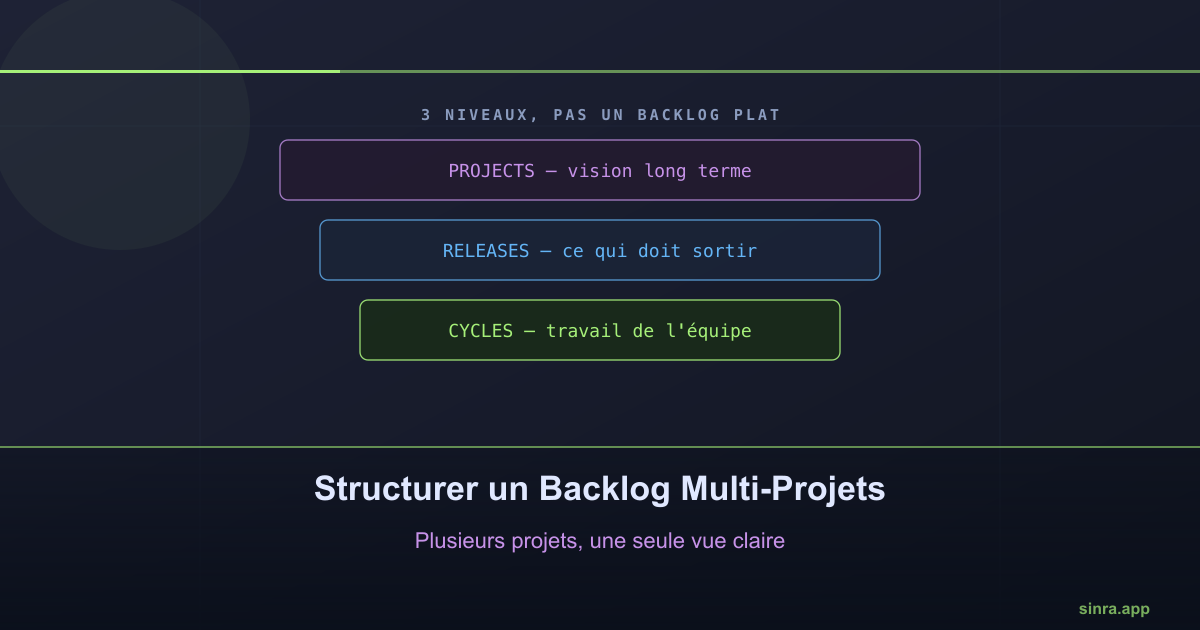
How to Structure a Backlog When Several Projects Run in Parallel
A single backlog mixing three projects is not a backlog: it is a list where nobody finds anything. Here is how to structure it without over-fragmenting it.
A team moving several projects forward in parallel almost always runs into the same problem: the backlog becomes a catch-all where items from different projects mix together, and nobody can tell, without opening each ticket, which project it belongs to and what its relative priority is.
The symptom: a flat backlog does not scale
A backlog organized as a flat list works for a single project, with a single team, over a short duration. As soon as a second project starts in parallel, this flat structure stops being enough. Sorting by priority becomes ambiguous: the priority of an item from project A does not make sense compared directly to one from project B, since they are two different contexts.
The visible result: prioritization meetings that drag on, because you are trying to compare things that are not comparable on the same axis.
Three levels, not one
The structure that works separates three distinct levels, rather than flattening everything into a single backlog.
The project level, for the long-term vision. A project gives a roadmap view of what is planned over several quarters, without committing to execution detail. This is the level where you answer “what is in the pipeline for this initiative over the next six months”.
The release level, for what needs to ship. A release groups the capabilities that need to be delivered together, regardless of their originating project. A release can very well contain capabilities from two different projects if they ship at the same time.
The cycle level, for the team’s actual work. A cycle contains the issues the team commits to over a short period, drawn from the current priority capabilities, regardless of which project they originated from.
Why this separation avoids the mix-up
This three-level structure avoids confusion because it answers different questions at different times. A stakeholder asking “where does project X stand” checks the project level. A team planning its work for the week checks the cycle. Nobody needs to directly compare items from different projects at the same level of detail.
Prioritization becomes an explicit tradeoff, not an implicit one
Without this structure, prioritization between projects happens implicitly: whoever shouts loudest, or whichever ticket was created last, moves forward. With a clear separation between projects, releases and cycles, the tradeoff becomes explicit: when composing a cycle, the team consciously chooses which capabilities, from which projects, enter the upcoming period. The decision is visible, documented, and can be explained to any stakeholder.
What it changes day to day
A team that adopts this structure does not work faster overnight. What changes is the ability to answer immediately “why isn’t this project moving this week” without digging through a flat backlog of several hundred items. The clarity of the structure replaces the individual memory of who decided what.
Ready to Transform Your Project Management?
Apply these insights with Sinra - the unified platform for modern teams.
Start Free Trial