 sinra
sinra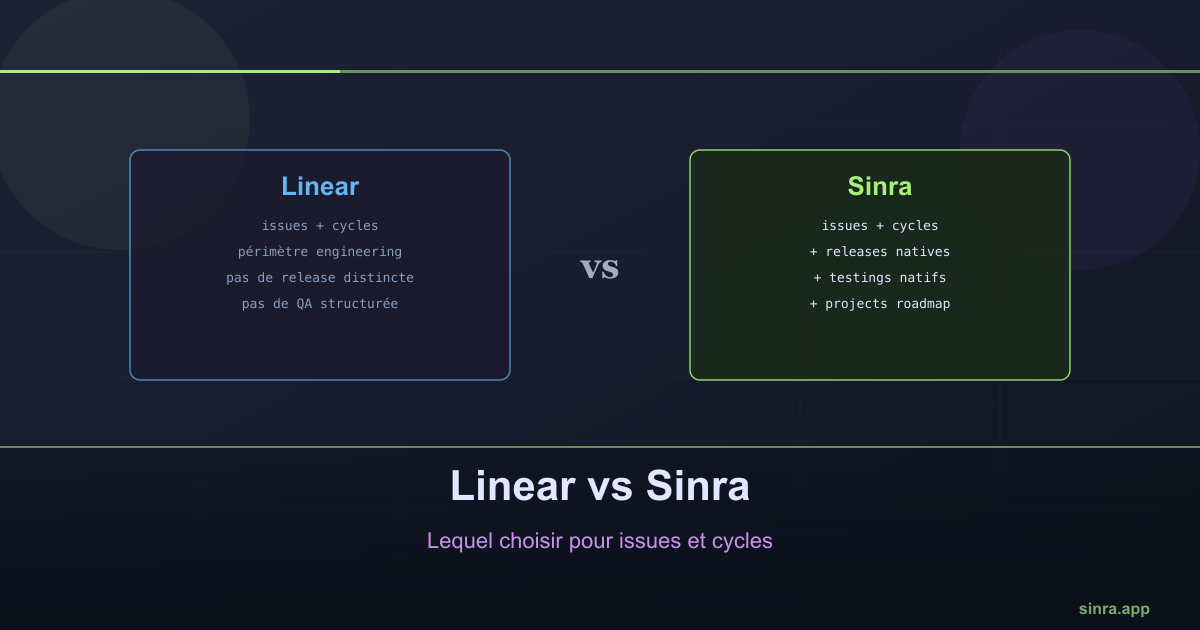
Linear vs Sinra: Which One to Choose for Issues and Cycles
Linear redefined speed of use for issue tracking. The question is not which tool is better, but which one matches the scope of what you actually need to run.
Linear made its mark by rethinking the speed of use of issue tracking for development teams. Sinra shares a common conviction with Linear: classic Scrum vocabulary (sprint, epic, story point) adds unnecessary abstraction. Both tools use the word cycle. But their respective scope diverges once you go past that common ground.
What Linear does very well
Linear built its reputation on execution speed: keyboard shortcuts everywhere, a clean interface, native Git sync. For a purely engineering team tracking its issues day to day, Linear is hard to beat on pure usage fluidity.
Linear’s scope stays centered on the issue and the development cycle. That is a deliberate choice: do one thing, do it fast and well.
What falls outside Linear’s scope
That same choice has a tradeoff: Linear does not natively cover a product release distinct from the development cycle, structured QA, or a long-term roadmap view shared with non-technical stakeholders. Teams that need these layers often manage them in complementary tools, which recreates the exact dispersion these tools were meant to avoid.
Sinra’s broader scope
Sinra picks up Linear’s concrete-vocabulary spirit and extends it to the whole product cycle. Issues and cycles work in a similar way. But Sinra adds releases natively as a concept distinct from the work cycle, testings as structured QA tracking, and projects as a roadmap view for planning several quarters ahead. Pages give a documentation space linked directly to the work, without depending on a third-party tool.
How to decide
If your team is purely engineering, with a tracking scope limited to the issue and the development cycle, and you already manage release, QA and documentation separately with tools that work well for you, Linear remains a solid, fast choice.
If you are looking to bring together development tracking, release preparation, QA and product documentation in a single tool, without multiplying integrations between specialized tools, Sinra’s broader scope answers a need that Linear does not natively cover.
The shared vocabulary should not mask the real question: how far do you want a single tool to follow you, from the individual ticket all the way to the shipped release?
Ready to Transform Your Project Management?
Apply these insights with Sinra - the unified platform for modern teams.
Start Free Trial