 sinra
sinra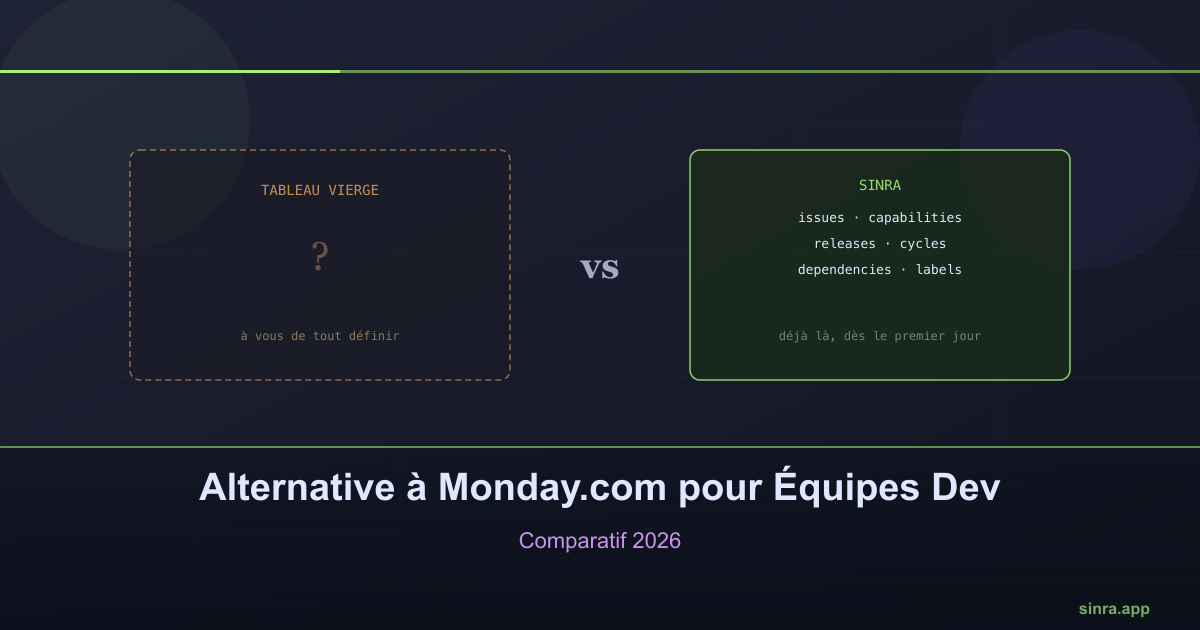
Monday.com Alternative for Dev Teams: 2026 Comparison
Monday.com shines with colorful boards and visual flexibility. For a development team, that total flexibility quickly turns into a blank page you have to structure yourself.
Monday.com built its reputation on visual flexibility: colorful boards, configurable automations, an interface that adapts to almost any workflow. For a software development team, that promise of total flexibility hides a cost discovered only after purchase: everything has to be built.
Flexibility as a blank page
Monday.com assumes nothing about the nature of the work. That is an asset for a team with very specific processes tied to its own business. It is a handicap for a development team that needs concepts already thought through: a release, a work cycle, a capability, a bug report.
Building these notions from generic boards takes time, a person who maintains the configuration, and collective discipline so that everyone uses columns and statuses the same way. Over time, this configuration drifts: two teams on the same project end up with slightly different boards, and comparing them becomes difficult.
Development vocabulary absent by default
Monday.com does not natively speak the language of software development. No built-in release tracking, no distinction between a bug and a feature at the data model level, no notion of dependency between technical work items. All of this can be simulated with custom columns, but every simulation is extra maintenance overhead.
An alternative built from software development
Sinra starts from the opposite direction: software development concepts exist by default, with no configuration needed. Issues cover bugs and tasks with a model adapted to each. Capabilities group related features. Releases track progress toward a shippable version. Cycles structure work into iterative periods. Labels and dependencies between issues are native, not rebuilt.
The result: no blank page to fill before starting to work. A team creates its organization and immediately finds a vocabulary that matches its own work.
Where Monday.com remains relevant
This comparison is not one-sided. If your team manages non-standard processes that are hard to fit into a classic software development vocabulary, Monday.com’s total flexibility remains a real asset. The question to settle is how much ongoing configuration cost you are willing to bear so the tool reflects your working reality.
For a development team that wants a tool already speaking its language from day one, generic flexibility stops being an advantage and becomes extra work to manage.
Ready to Transform Your Project Management?
Apply these insights with Sinra - the unified platform for modern teams.
Start Free Trial