 sinra
sinra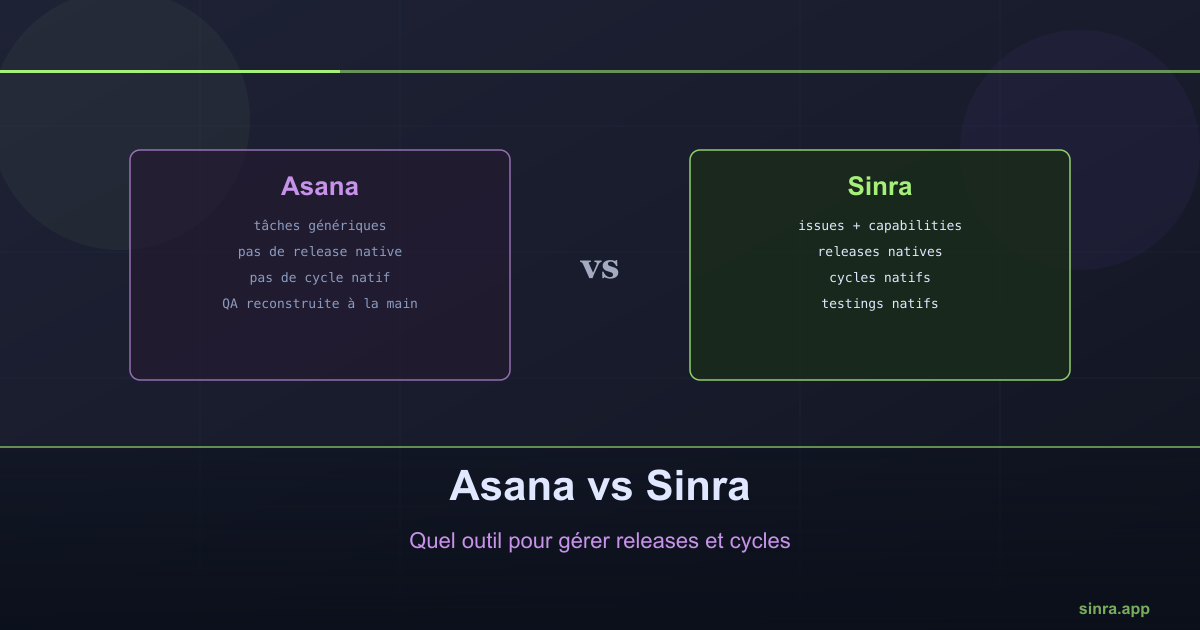
Asana vs Sinra: Which Tool for Managing Releases and Cycles
Asana excels at cross-functional task management. It was not built around the concept of a software version. Here is where each tool actually belongs.
Asana established itself as a generalist task management tool, adopted by marketing teams as much as by product teams. Sinra starts from a different premise: being built specifically for teams that develop and ship software. That difference in design shapes everything else.
What Asana does well
Asana offers flexible views (list, board, calendar, timeline), solid task management, and a gentle learning curve. For a team managing cross-functional projects, where technical work is only part of the scope, Asana remains a relevant choice.
Asana’s strength is its genericity: a task is a task, whether it concerns a marketing campaign, a hiring process, or a product feature. This genericity lets the whole organization use the same tool.
What is missing when the work is software development
That same genericity becomes a limitation for a development team. Asana has no native notion of a release: no concept that answers “what is shipping in version 2.4, and is it ready?”. This logic has to be manually recreated with tags, nested projects, or custom fields.
The same goes for the notion of a work cycle. Asana handles deadlines and timelines, but not natively the idea of an iterative work period with content defined in advance and a review at the end. Teams that want this behavior simulate it with recurring project templates, which works but requires constant upkeep.
Finally, QA tracking (tests, regressions, validation before release) has no dedicated place in Asana. It ends up scattered between generic tasks and external tools.
What Sinra does differently
Sinra starts from software work rather than the generic task. Issues are the fine-grained unit of work. Capabilities group features to be delivered. Releases directly answer “what is shipping and when”. Cycles structure work into defined periods, with their own content and their own review. Testings give QA a native place, instead of treating it as just another task.
This specialization comes at a cost: Sinra is not built to manage a marketing campaign or a hiring plan. It is built to do one thing, and do it well.
How to choose
If your organization needs a single tool for every type of work, marketing included, and software development is only part of the scope, Asana remains coherent.
If your team develops and ships a software product, and you find yourself artificially recreating releases and cycles with tags and recurring projects, that is the signal that the generalist tool has reached its limit for this specific use case.
The question is not “which tool is better” in the abstract, but “does my main type of work have native concepts in the tool, or am I constantly rebuilding it with the generic building blocks available?”
Ready to Transform Your Project Management?
Apply these insights with Sinra - the unified platform for modern teams.
Start Free Trial