 sinra
sinra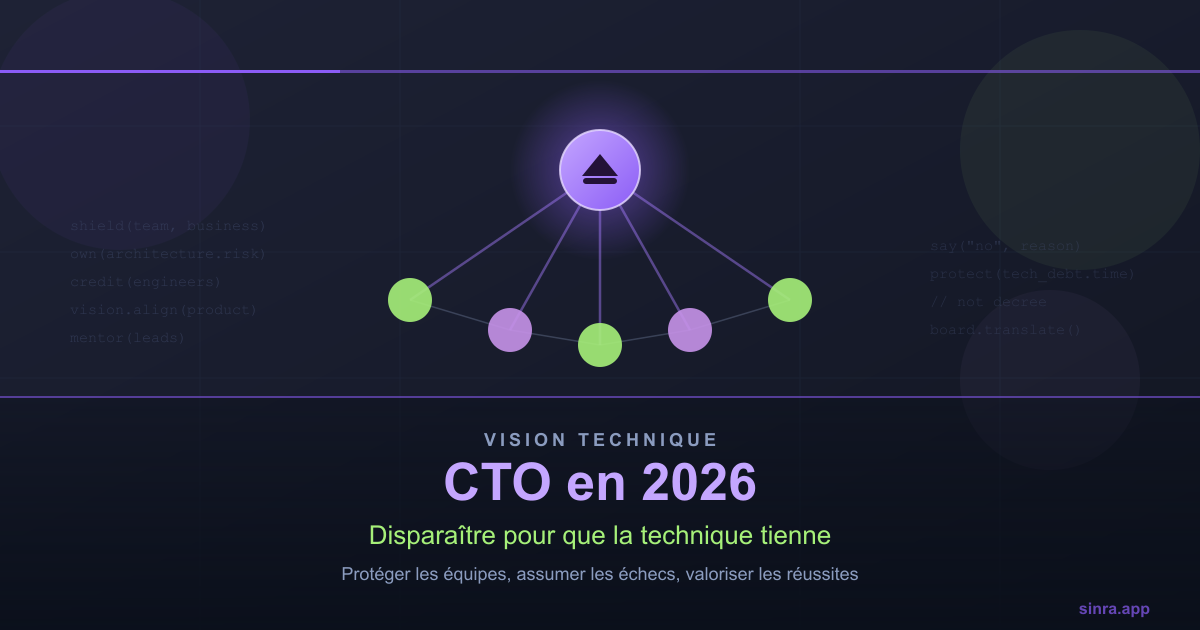
Being a CTO in 2026: the role that consists of disappearing so the engineering holds
What this role really represents in a company, and why most of the work happens far from the code
The CTO is often seen as the most experienced developer in the company, the one with final say on technical choices. That picture is incomplete, and gets more wrong as the company grows. In 2026, with distributed stacks, constant security concerns, and business pressure that never lets up, the CTO role has moved far from the keyboard.
That shift isn’t a loss. It’s the very nature of the role: the bigger the company grows, the less the CTO should code, and the more they should build the conditions under which everyone else codes well.
The interface between the board and the code
The CTO occupies a rare interface position: translating business strategy into technical decisions, and translating technical constraints into language leadership, investors, or the board can understand. That two-way translation is the core of the job, far more than any specific technical skill.
Three tensions structure this role permanently:
- Business tension: the market wants speed, features, growth that never stops.
- Technical tension: a system that must stay reliable, secure, and evolvable, without collapsing under its own weight.
- Human tension: engineering teams that need to stay motivated, trained, and protected from an unsustainable pace.
A CTO who systematically favors business ends up exhausting their teams and accumulating invisible technical debt until it explodes. A CTO who systematically favors engineering loses leadership’s trust and ends up isolated. The good CTO navigates these three tensions continuously, never pretending one of them has permanently won.
Absorbing business pressure in place of engineering
The hardest part of the job is accepting to act as a shield between often unrealistic business goals and engineering teams that need good conditions to build.
When leadership promises a feature for an impossible date, when a strategic client demands urgent development that will create debt, when a board asks for quarterly results on a system that needs deep refactoring, it’s the CTO’s job to absorb that pressure before it reaches the teams in a raw, anxiety-inducing form.
That means:
- Negotiating deadlines upstream, with solid technical arguments, rather than passing untenable deadlines straight through.
- Saying no, or proposing a viable alternative, when a request endangers system stability, even if it creates friction with leadership.
- Protecting time for technical debt and skill-building, even when everyone in the company is pushing for more speed.
- Taking the political hit when a necessary technical choice slows a delivery, rather than letting that responsibility fall on the team executing it.
This sacrifice isn’t free. It costs political capital, sometimes short-term credibility with impatient executives. But that political capital, spent at the right moment, is what protects the company’s ability to deliver properly over the long term.
Carrying alone the weight of an architecture that breaks
When a technical choice turns out badly - an architecture that doesn’t scale, a poorly anticipated migration, a security incident - the CTO carries the responsibility in front of leadership and clients, even if the initial decision was made collectively or by a technical lead.
This responsibility doesn’t exclude an honest internal analysis: understanding what went wrong, adjusting processes, avoiding repetition. But outside the engineering team, the CTO never points a finger at a specific person or team for a collective failure.
Conversely, when a major technical win arrives - a migration with zero downtime, a redesign that cuts infrastructure costs by three, a system holding up under unprecedented load - the CTO must make sure recognition flows back to the people who did the work, by name, in front of leadership and the whole company if possible.
A technical direction that gets built, not decreed
The CTO has considerable influence over architecture and stack choices, by position and experience alone. Used badly, that influence quickly turns technical decisions into top-down dogma, applied without real buy-in from the teams who have to live with those choices day to day.
Good practice is to set a clear technical direction, but build it with leads and teams, not decree it alone from an office. Present the stakes, the constraints, the viable options, and let technical teams challenge, adjust, and own the final decision. The CTO’s role is to guarantee overall coherence, not to dictate every implementation detail.
This posture also applies to growing technical leads themselves. A CTO who trains their leads to make good decisions on their own builds a technical organization that stands without them. A CTO who centralizes every decision creates a fragile dependency that collapses at the first surprise.
Investing before the urgency does it for you
Finally, an effective CTO spends a significant part of their time upstream of product roadmaps, not reacting to already-fixed requests. Understanding where the business wants to go in six months to a year lets you anticipate necessary technical investments - an infrastructure migration, a security hardening effort, an architecture overhaul - before urgency forces them under bad conditions.
This anticipation requires real closeness with leadership and product, an understanding of business goals beyond the technical backlog, and the ability to translate that understanding into concrete priorities for engineering teams.
Being a CTO in 2026 isn’t recognition of individual technical skill. It’s a role measured by the solidity of the technical organization once you’re absent - on vacation, in a meeting with investors, or simply not in the room when a decision needs to be made.
A good CTO builds a system where engineering stands on its own without constantly depending on their presence. It’s a job of progressive erasure, not power accumulation.
Ready to Transform Your Project Management?
Apply these insights with Sinra - the unified platform for modern teams.
Start Free Trial