 sinra
sinra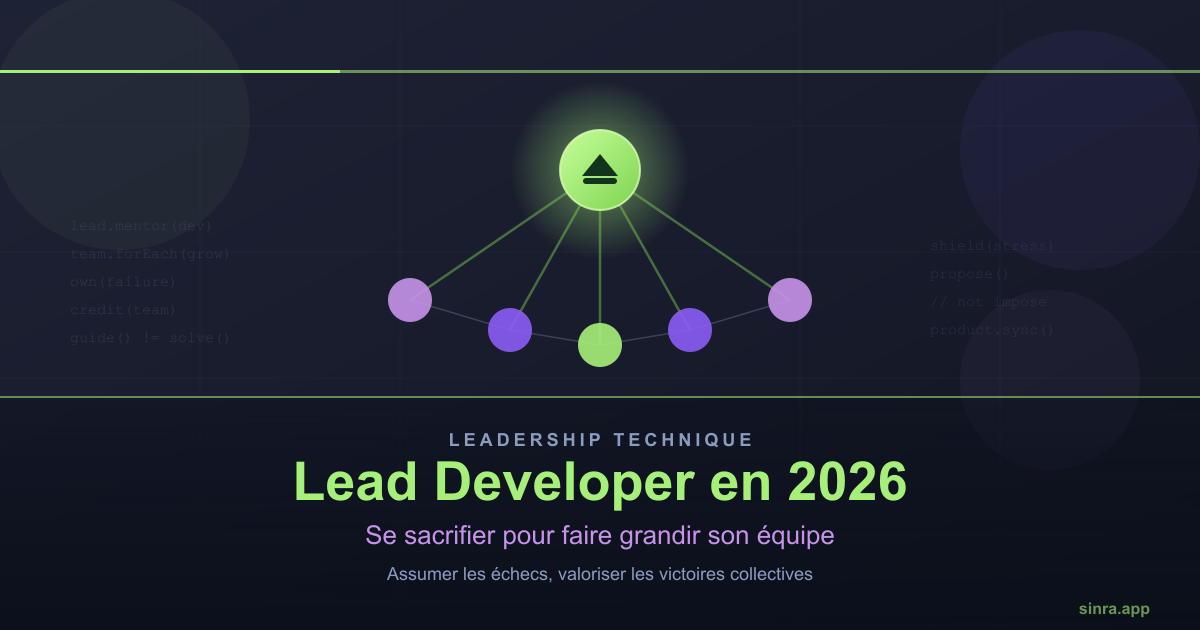
Being a Lead Developer in 2026: the role you never understand until you're in it
What this role really represents in a company, and why 80% of the job is stepping back for your team
Becoming a Lead Developer is often framed as a promotion. More responsibility, more recognition, sometimes more pay. What gets talked about less is that the role takes as much as it gives: less personal coding time, less direct credit for technical achievements, and a mental load that never shows up in a job description.
In 2026, with distributed teams, stacks evolving faster than ever, and constant product pressure, the Lead Developer role has grown more complex. It’s no longer just “the senior developer who reviews everyone else’s code.” It’s a hinge function between product, technology, and people, where most of the work can’t be measured in lines of code written.
A role at the crossing of three contradictory demands
A Lead Developer occupies a peculiar position: not quite a manager, not quite an individual contributor. This hybrid position is often misunderstood, both by the organization and by the lead themselves at first.
Within an organization, the Lead Developer is the convergence point of three needs pulling in different directions:
- The product need: ship fast, adapt to shifting priorities, respond to market demands.
- The technical need: keep the architecture healthy, avoid accumulating debt, ensure the system stays evolvable.
- The human need: a motivated team that grows its skills and doesn’t burn out, that wants to stay.
A good Lead Developer doesn’t favor one of these needs at the expense of the other two. They constantly search for the balance point, knowing that balance shifts every week depending on context. It’s a role of permanent tension, not comfort.
Why you give away the best problems, never keep them
Here’s the most counterintuitive part of the role, and probably the hardest to accept for someone who got promoted because they were an excellent developer: as a lead, you have to give the most interesting problems to your team, not keep them for yourself.
The natural instinct, especially early on, is the opposite. You were the best technician, you know the complex subject better than anyone, so you keep it. It’s faster, more comfortable, less risky in the short term.
But it’s a strategic mistake. A team that only gets repetitive or secondary tasks while the lead keeps the stimulating problems doesn’t grow, gets bored, and eventually leaves. Conversely, a team entrusted with real technical challenges - even imperfectly solved at first - builds skill, gains autonomy, and develops a sense of ownership over the product that no bonus can replace.
Concretely, this means the lead spends a large part of their time:
- Identifying which problem will grow which developer, at the right moment in their progression.
- Preparing the ground ahead of time: clarifying the problem, reducing ambiguity, asking the right questions, without doing the work in someone else’s place.
- Staying available while someone else takes on a problem the lead could have solved twice as fast.
- Accepting the relative slowness this implies, because the mid-term gain (a team that has grown) far outweighs the short-term cost (a task that takes longer).
This isn’t disinterested altruism. It’s a deliberate calculation: the lead’s role is no longer to produce the best solution individually, but to maximize the team’s collective capacity to produce good solutions, again and again, with or without them.
Fail alone, win as a group
A simple principle, rarely upheld over time: failures are personal, victories are collective.
When a project goes sideways, an incident hits production, or a technical choice turns out badly, the lead takes responsibility in front of leadership or the client, even if the operational decision came from a team member. This isn’t about covering serious mistakes or negligence - it’s about protecting the psychological space in which a team can take risks, try things, and sometimes get it wrong without fearing disproportionate punishment.
Conversely, when a success arrives, the reflex should be to highlight the people who did the work, by name, publicly, in front of the right people. Not a vague “we shipped it.” Saying “Julie fixed the performance issue that had been blocking us for three weeks” has a completely different impact than “the team made good progress.”
This deliberate asymmetry - absorbing the negative, redirecting the positive - is what builds long-term trust. A team that knows its lead has their back in failure and highlights them in success takes more risks, innovates more, and communicates more honestly about its struggles.
Convincing without ever deciding in the team’s place
The Lead Developer has disproportionate influence over technical decisions, almost by definition: more experience, more overview, often more tenure in the product’s context. This influence is a powerful tool, and just as powerful a trap.
The trap is turning that influence into imposed authority: “we do it this way because I decided so.” It works in the short term, but it kills engagement and learning over the long term. A team that executes decisions it didn’t understand or discuss never develops the judgment needed to make the right calls on its own later.
The alternative, slower but more durable: propose technology choices without ever imposing them. Present the options, explain the trade-offs, lay out your own reasoning transparently, and let the team reach its own conclusion, even if it aligns with the lead’s nine times out of ten. The path matters as much as the destination.
This principle extends to day-to-day mentoring. When a developer is stuck on a problem, the fastest reflex is to give the answer. It’s also the least useful in the long run. Helping find a path rather than handing over a ready-made answer takes more patience: asking questions that guide the thinking, suggesting a direction without fully unrolling it, letting the person arrive at the solution themselves, even if it takes three times longer than a direct answer.
That invested time is never wasted. A developer who finds their own solution retains the problem-solving process, not just the result. Next time, they’ll need less help.
Standing between the pressure and the team
Another often-underestimated aspect of the role: the lead acts as a buffer between external pressures (tight deadlines, last-minute priority changes, unhappy clients, an impatient leadership team) and a team that needs to keep producing quality work.
This doesn’t mean hiding reality or lying about difficulties. It means filtering how the pressure gets transmitted. A lead who passes their own stress straight through to their team, unprocessed, is transferring a management problem instead of solving it. The work consists of absorbing part of that tension, reformulating it into clear, actionable priorities, and protecting the focus time needed to build well.
This protection applies no matter the subject, including ones the lead doesn’t particularly enjoy handling: interpersonal conflicts, friction with other teams, or unpopular decisions from above. Supporting the team isn’t just about the pleasant technical topics, but also the uncomfortable organizational ones.
Talking to product before the spec exists
Finally, an effective Lead Developer doesn’t work in reaction to specs that arrive. They collaborate closely with product, upstream of spec writing, to anticipate upcoming development and provide technical guidelines before the writing work even begins.
This anticipation fundamentally changes the quality of the work that follows. A spec written without prior technical consultation often contains unrealistic constraints, unanticipated dependencies, or choices that ignore limitations of the existing system. A spec written after a discussion with the technical lead bakes in these constraints from the start, avoiding costly back-and-forth later in the development cycle.
This bridging role requires the lead to understand enough of the product context - business goals, user constraints, mid-term vision - to steer technical choices accordingly, without substituting themselves for decisions that belong to product.
Being a Lead Developer in 2026 isn’t a superior version of being a developer. It’s a different job, one that uses technical expertise as a foundation but is played out elsewhere: in the ability to grow others faster than you’d grow yourself by keeping everything for yourself.
The paradox of the role fits in one sentence: the more successful you are as a lead, the less individually visible you become, and the more visible your team becomes. That’s exactly the sign you’re doing your job well.
Ready to Transform Your Project Management?
Apply these insights with Sinra - the unified platform for modern teams.
Start Free Trial