 sinra
sinra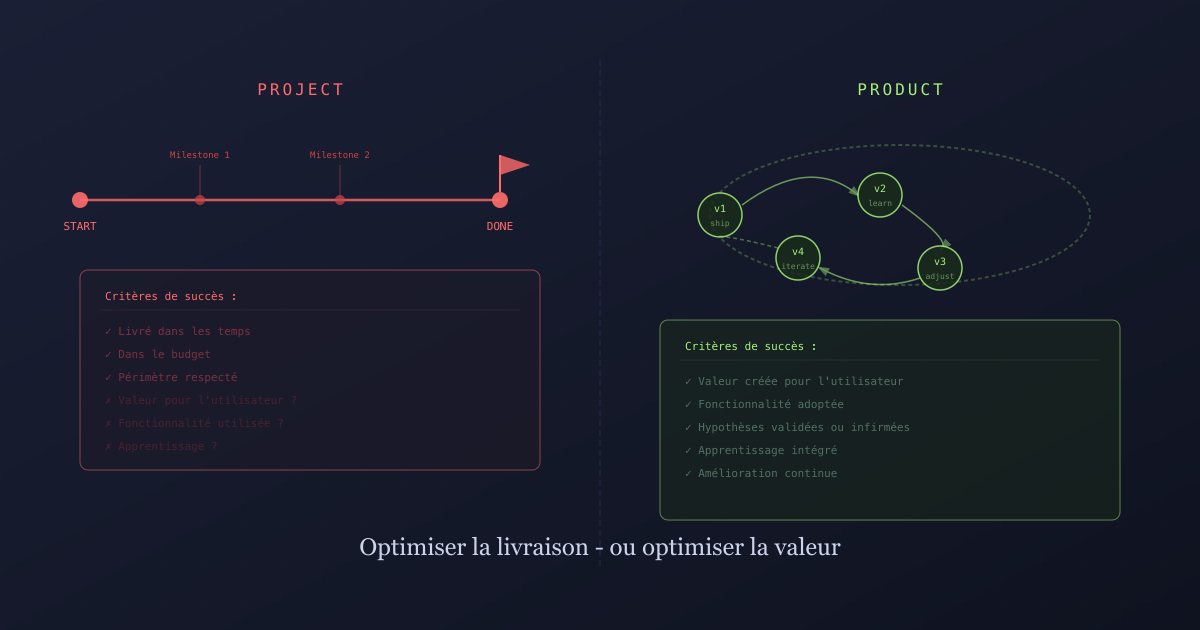
Product mindset vs Project mindset: a fundamental difference
Many teams that call themselves 'product teams' are actually operating in project mode. The scope is fixed, the deadline is sacred, and nobody measures value after delivery. This confusion has real consequences on what gets built and why.
There is a confusion that runs through many development teams. They talk about “product teams,” hire “product managers,” use product management tools - and yet in practice, they work as if every quarter were a project to be delivered.
This is not a vocabulary problem. It is a problem of what you optimize for. And it has direct consequences on the quality of what gets built, on user satisfaction, and on a team’s ability to learn and improve.
What project mindset means
Project mindset is a way of thinking inherited from classical engineering and construction. A project has:
- A scope defined upfront
- An allocated budget
- A start date and an end date
- Intermediate milestones
- A simple success criterion: did we deliver on time and on budget?
This logic works well for building a bridge or renovating a building. The requirements change little between start and finish. The needs are known. Success is measured at delivery.
In software development, this framework is problematic for a simple reason: needs change along the way. What seemed necessary at the start of a project is often no longer a priority six months later. What users actually want is sometimes only visible after you put something in their hands.
Project mindset responds to this by ignoring that signal, or deferring it to “the next project.” The priority is to deliver the defined scope.
What product mindset means
Product mindset starts from a different premise: we do not know upfront everything users need. We have hypotheses. We test them. We learn. We adjust.
In this framework, delivery is not the end. It is the beginning of a learning cycle. A delivered feature that is not used is a failure, even if it was delivered on time and on budget. An imperfect feature that solves a real problem for users is a success, even if it took longer than expected.
The success criterion is not “did we deliver?” but “does this create value for users?”
This difference changes everything: how you plan, prioritize, measure, and decide what to do next.
Why product teams operate in project mode
The confusion is common because it comes from real organizational pressures.
Annual budgets impose a project framework. In many organizations, budget is allocated once a year, per project or initiative. The team must justify what it will deliver to secure funding. This mechanism naturally creates a fixed scope and a delivery logic.
Milestones reassure management. A roadmap with dates and named features is easier to present to leadership than a rolling horizon based on bets to test. The apparent certainty of fixed scope is reassuring, even if it is illusory.
Delivery culture trumps value culture. In many teams, what gets celebrated, measured, and highlighted in retrospectives is what was shipped. Not what worked. Not what was learned. Not what changed for users.
The result: teams using product vocabulary (sprints, backlogs, product owners) but operating with project logic (fixed scope, sacred deadline, no feedback loop after delivery).
The concrete consequences
This confusion is not abstract. It produces predictable and costly outcomes.
Features delivered but unused. Repeated studies on mature codebases show that a large proportion of developed features are rarely or never used. These features cost time, effort, and code complexity. They were delivered because they were in scope, not because they addressed a validated need.
No feedback loop. When the logic is to deliver and move to the next project, nobody comes back to measure the impact of what was delivered. The team does not learn whether its hypotheses were correct. It cannot refine its judgment about what works.
Optimizing speed over direction. A team in project mode optimizes for “moving fast toward the defined scope.” A product team optimizes for “moving in the right direction.” These two optimizations can lead to opposite decisions about what to do and in what order.
Resistance to legitimate change. When the scope is sacred and the deadline is approaching, any signal that should shift priorities is perceived as a threat. “We can’t change now, we’re in the middle of a delivery.” This is often a rational response in a project - and a dysfunctional one in a product.
Markers of product mindset in practice
How do you recognize a team that truly operates in product mode?
It measures impact after delivery. Two weeks, one month, one quarter after a feature goes live: is it being used? Did it change anything for users? These questions are asked, and the answers influence the next decisions.
It is comfortable with scope uncertainty. The roadmap says “we think it is worth working on X this quarter.” Not “we will deliver exactly X, Y, and Z before September 30.” The difference is subtle in words, but enormous in reality.
It can cancel or pivot without it being a failure. Deciding not to finish a feature because signals indicate it does not address the right problem is a success in product logic. In project logic, it is a failure.
It learns and integrates what it learns. The decisions of the next quarter are influenced by what worked and what did not in the previous one. The team has a collective memory of its learnings.
Moving from project to product
The transition is not just a process change. It is a change in what is considered success.
Some concrete levers:
Separate planning horizons. Long-term vision (where we want to go), medium-term priorities (what we are betting on), short-term concrete work (what we are doing this week). Each horizon has its own logic and its own level of certainty.
Measure value, not scope. Define before starting: how will we know it worked? What signal are we looking for in usage data, in user feedback, in business metrics?
Create short learning cycles. Ship something incomplete but usable earlier to get real signals. Adjust. Repeat. The truth is in usage, not in specifications.
Name the hypotheses. Explicitly state “we believe users need X because Y” before developing. This creates the possibility of learning whether the hypothesis was correct.
What Sinra builds for this way of working
Sinra is designed to operate in product logic, not project logic.
Successive releases allow delivery in increments and measurement of each increment’s impact before deciding what comes next. Cycles organize work in defined periods without locking the overall scope. Capabilities in projects provide a long-term view of intentions without creating rigid commitments on exact content.
This structure reflects a philosophy: we do not know everything upfront. We make bets, we ship, we learn, we adjust. This is not improvisation. It is rigor applied to the real uncertainty of software development.
Project mindset is not inherently bad. There are contexts where it is perfectly appropriate: a well-scoped technical migration, an infrastructure overhaul with a known scope, a regulatory project with fixed constraints.
But for a software product that evolves with its users, project logic is a handicap. It optimizes for the wrong thing and makes the learning that would enable improvement difficult.
The question is not “are we in project mode or product mode?” The question is: “are we optimizing to deliver the scope, or to create value?” These two objectives do not lead to the same place.
Ready to Transform Your Project Management?
Apply these insights with Sinra - the unified platform for modern teams.
Start Free Trial