 sinra
sinra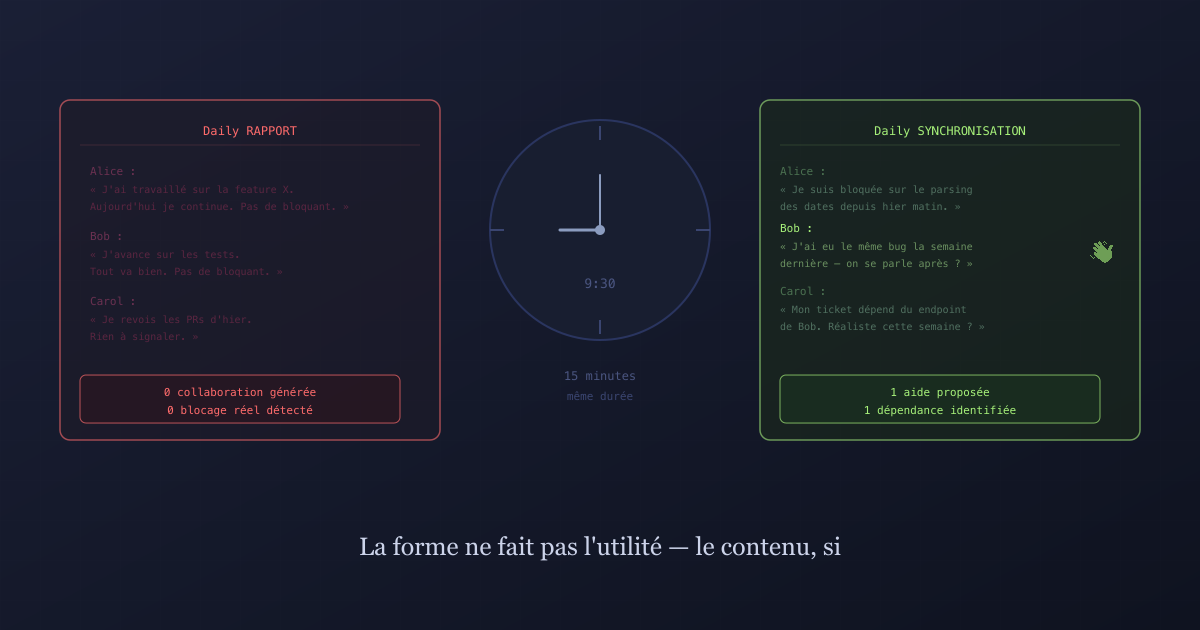
Why Daily Standups Are Often Useless
The daily standup is one of the most universally practiced rituals in development teams. It is also one of the most frequently misused - transformed into a status meeting from which nobody leaves with anything useful.
There is a strange asymmetry in discussions about daily standups. Most developers, if you ask them privately, will tell you their daily is often useless. Many managers will tell you that dailies are essential. This divergence is not a disagreement about the tool. It is a disagreement about how it is used.
The developer who finds their daily useless is often right. Not because dailies are intrinsically useless - they can be - but because the daily in its common practice has often become something very different from what it is supposed to be.
What the Daily Standup Is Supposed to Accomplish
The daily standup in the Scrum method has a precise and limited goal: synchronize the team around its progress toward the sprint goal, and identify the obstacles preventing that progress.
It is not a status meeting for the Scrum Master or the manager. It is not an activity report. It is not a problem-solving session.
The three classic questions (what did I do yesterday, what am I doing today, what are my blockers) are a memory aid for structuring a quick synchronization. They are not an end in themselves.
The original intention: in fifteen minutes, the team has a shared view of where it stands, and each member knows whether there is something requiring their immediate collaboration.
The Drift Toward the Status Report
In practice, many dailies have drifted toward something different: an individual activity report addressed to the Scrum Master or the manager.
How to recognize this drift:
Answers to the three questions are addressed to one specific person (the Scrum Master, the lead, the manager) rather than to the team. The speaker’s gaze goes toward that person rather than scanning the whole team.
Blockers are not mentioned. Team members do not share their real blockers because declaring a blocker publicly is perceived as admitting weakness or being behind schedule. People declare clean blockers (“I’m waiting for the API validation”) but not real problems (“I’ve been stuck on this issue for two days and I don’t understand why”).
Answers are vague and generic. “I’m making progress on feature X” says nothing. It is an answer that satisfies the form without exposing any real information.
The daily takes more than fifteen minutes. Not because important topics are being discussed, but because discussions drag on about subjects that only interest two people out of the ten present.
Nothing changes after the daily. The team returns to its work in the same state as before. Nobody offered help, nobody identified a critical dependency, nobody decided to talk outside the meeting to resolve a problem.
Why the Status Report Replaces Synchronization
This drift is not accidental. It reflects a real power dynamic within teams.
When a manager or lead is present at the daily, team members adapt their behavior. They speak in ways that make them appear productive and active. They minimize difficulties. They avoid exposing uncertainties that might be interpreted as incompetence.
This is not bad faith. It is rational behavior in a context where individual performance is evaluated and where difficulties can affect that evaluation.
The result: the daily becomes a performance. Everyone says what they are expected to say, in the expected order, within the expected time. The information that would actually be useful (the real difficulties, the real uncertainties, the real needs for collaboration) does not circulate.
What Makes a Daily Useful
A useful daily is not defined by its format but by what it produces.
At the end of a useful daily, at least one of the following things has happened:
Someone offered help to someone else. “You seem stuck on X - I had the same problem last week, want to talk after?” This is the core value of synchronization: enabling colleagues to find each other.
A risk was identified. “While working on Y yesterday, I realized it depends on Z which isn’t done yet. This could block the delivery.” This information allows the team to adapt its plan.
A dependency was surfaced. “I’m going to need the endpoint you’re developing by end of week. Is that realistic?” The conversation organizes itself.
A real blocker was expressed. “I’ve been trying to figure out why this function isn’t working as expected for two days. I need help.” The team can react.
A daily where none of these things happens is a daily that has not fulfilled its purpose. Not because the format was wrong, but because the information that would have made these exchanges possible did not circulate.
The Alternative Format: Around the Board
A practice that changes the dynamic of the daily in many teams: holding the daily around the task board (physical or digital), going through tickets rather than people.
Instead of asking each person “what did you do,” you walk through the board from right to left (from “done” toward “to do”). For each ticket in progress, you ask: is this moving along well, is there a risk, is there a dependency?
This format has several advantages.
It focuses attention on the flow of work, not on individual activities. The relevant question is not “what is each person doing” but “are tickets moving toward delivery.”
It reveals blockers naturally. A ticket that hasn’t moved in two days becomes visible without the person having to admit it verbally.
It reduces individual performance pressure. You are talking about the ticket, not the person. The distinction is subtle but real in the meeting’s dynamic.
When to Eliminate the Daily
There are contexts where the daily provides no value and should be eliminated or replaced with something else.
Very small teams with continuous communication. Two or three developers working in the same space and communicating naturally do not need a daily synchronization ritual. Their coordination is ongoing.
Teams with very different rhythms. A daily at 9:30 that requires all team members to be synchronized early in the morning can be counterproductive for members who are more effective in the afternoon, or who have personal constraints that do not fit this time slot.
When the daily duplicates other effective rituals. If a team already has natural informal standups several times a day, a formal additional daily is redundant.
During deep work phases. Some development phases require long blocks of uninterrupted time. Forcing a daily synchronization during these phases fragments focus without delivering proportional value.
The alternative to a removed daily: an async communication channel where team members share their status and blockers at their own pace, with the responsibility to respond quickly when someone expresses a need for collaboration.
The Signal the Daily Sends About Culture
The way a team practices its dailies reveals something about its culture.
A daily where blockers are freely expressed and quickly resolved by the team says: here, it is safe to ask for help. Vulnerability is welcomed, not penalized.
A daily where nobody expresses a blocker and where everyone is “making good progress” says: here, expressing a difficulty is risky. Problems are resolved individually or remain stuck in the dark.
The format of the daily does not create this culture. But it reflects it, and depending on how it is facilitated, it can reinforce it or correct it.
The daily standup is a tool. Like all tools, its usefulness depends on how it is used.
A fifteen-minute daily where the team genuinely synchronizes, detects blockers, and organizes to help each other is worth more than any planning meeting.
A fifteen-minute daily where everyone reads their task list aloud is not worth the fifteen minutes it consumes.
The difference between the two is not the format. It is what the team considers acceptable to share, and what it does with what is shared.
Ready to Transform Your Project Management?
Apply these insights with Sinra - the unified platform for modern teams.
Start Free Trial