 sinra
sinra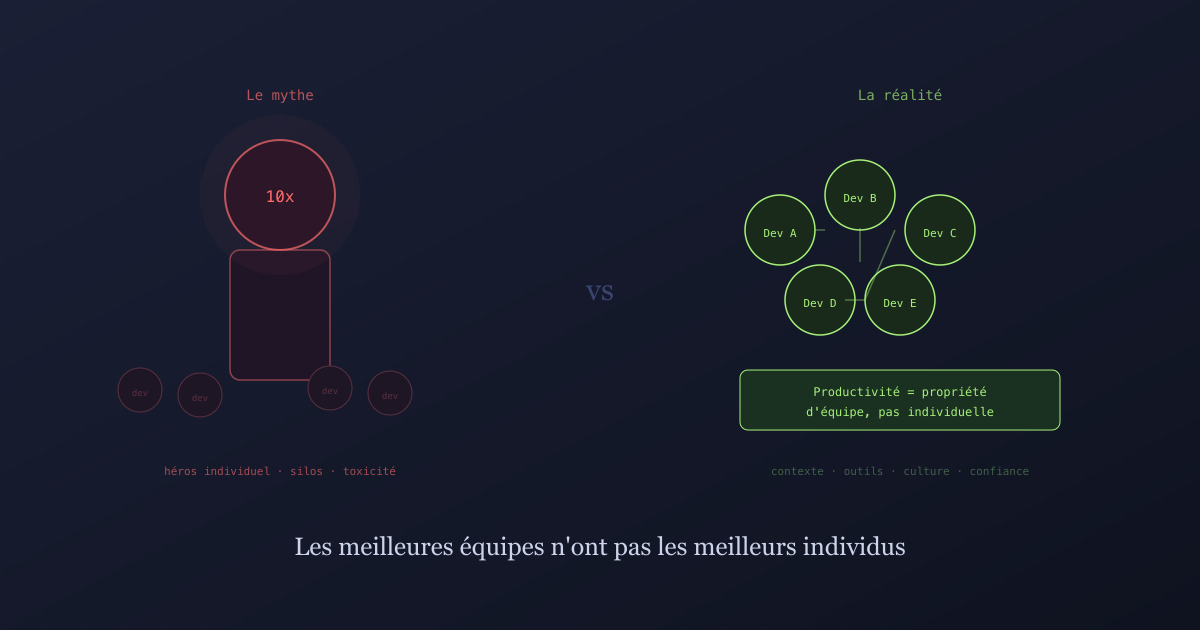
The Myth of the 10x Developer
A developer is supposedly ten times more productive than another. This idea has been circulating since the 1960s and influences hiring, compensation, and management decisions. It is based on misinterpreted data and produces toxic team dynamics.
In 1968, two American researchers, Sackman, Erikson, and Grant, published a study on programmer productivity. They observed that, across a set of programming tasks, the ratio between the fastest and slowest programmer in their sample was 28:1 for coding time, and 10:1 for other measures.
From this study, the software development world drew a conclusion: there exist developers ten times more productive than others. The “10x developer” was born.
Fifty years later, this concept still influences hiring decisions, salary structures, and team cultures in thousands of tech companies. And the study it is based on has major methodological problems that almost nobody mentions.
The Problems with the Original Study
The 1968 study had several significant flaws.
The sample was small (fewer than 20 programmers) and non-representative. The tasks were short individual exercises, not software development in a professional context. The programmers were not at the same experience level, nor working on the same types of tasks.
More importantly: the observed variability is partly a variability in individual performance (some developers are better than others at certain tasks), and partly a variability in context (some had more experience with the languages used, better working conditions, etc.). The study did not distinguish between the two.
The 10:1 ratio is an observation on a small sample in an experimental context. It was transformed into a universal claim about the distribution of productivity in the industry. This shift is a fundamental error of interpretation.
What “Productivity” Measures
Even if you accepted the ratio, there is a definition problem: productivity measures what, exactly?
Studies on developer productivity generally measure: lines of code written per unit of time, bugs resolved, features completed, or combinations of these metrics.
These measures have obvious problems. A developer who writes a lot of code is not necessarily more productive than a developer who writes less code but more precise, more maintainable, less bug-prone code. A developer who resolves many bugs may simply be working on easy bugs. A developer who completes many features may be working on simple ones, or implementing them with technical debt.
Individual productivity measures capture the quantity of what is produced, not the quality, not the impact on the team, not the value created for users.
Productivity as a Team Phenomenon
The 10x developer view assumes that software development productivity is an individual property: some developers have more, others have less.
Recent research on productivity in software development suggests a very different picture. The DORA (DevOps Research and Assessment) State of DevOps report, drawing on data from tens of thousands of developers, identifies “elite teams” that deliver software 200 times more frequently and with recovery times 2,600 times faster than the lowest-performing teams.
These differences are not explained by the presence of “10x developers.” They are explained by organizational practices: continuous integration, continuous deployment, a culture of continuous improvement, psychological safety, and modular architecture.
Software development productivity at scale is primarily a team property, not an individual one.
The 10x Developer in Reality
There are developers who, in certain contexts, produce significantly more than their peers. This reality does not contradict the previous argument. It nuances it.
Developers who appear as “10x” in certain teams generally have a combination of characteristics.
Deep contextual knowledge. A developer who knows a ten-year-old codebase intimately can respond to a problem in two hours that a newcomer would take two days to solve. This is not “10x productivity.” It is the value of contextual experience.
The ability to unblock others. Developers who seem very productive in good teams are often people who spend part of their time helping others move forward: answering questions, doing quick reviews, explaining architecture. Their personal impact is amplified by their impact on the team.
Access to better information. A senior developer who participates in architecture decisions, understands product priorities, and has the necessary access moves faster than a junior who must wait for clarifications at every step. This difference is not intrinsic productivity - it is information and autonomy.
These characteristics are reproducible. They are not mystical properties of exceptional individuals. They can be cultivated within a team: transmitting contextual knowledge, creating a culture of mutual support, providing access to information.
The Toxic Effects of the Myth
The 10x developer myth has concrete, measurable effects on team cultures.
Tolerance for problematic behavior. If an organization believes that certain individuals are ten times more productive than others, it is willing to tolerate difficult behavior from those individuals. The brilliant but arrogant engineer, the one who doesn’t share knowledge, the one who criticizes colleagues - all these behaviors are tolerated in the name of “talent.”
What these behaviors do to the team: they create fear, reduce communication, and discourage questions. In most cases, the negative impact of these behaviors on the team far outweighs the individual productivity of the person in question.
The undervaluing of teamwork. Contributions that make a team more effective without producing directly visible code - documentation, mentoring, thorough reviews, process improvement - are undervalued in a 10x developer culture. The productivity that counts is individual and measurable.
Biased recruitment dynamics. Searching for “10x developers” rather than good team members creates recruitment biases: favoring certain profiles (often men with specific demographic and social characteristics) at the expense of profiles that create value differently.
The hero syndrome. In a team where belief in the 10x developer is strong, individuals take on disproportionate responsibilities, create intentional knowledge silos (to maintain their indispensable status), and end up becoming bottlenecks for the team they were supposed to elevate.
What Usefully Replaces the Concept
The point is not to say that all developers are equally competent or that individual differences do not exist. They do exist, they are real, and they matter.
What matters is thinking about these differences in their context.
A highly skilled developer in a well-organized team, with good tools, a clear architecture, and smooth communication, contributes enormously. The same developer in a dysfunctional team, with broken tools, an incomprehensible architecture, and constant blockers, contributes far less. The difference in productivity is primarily that of context, not of the person.
Investing in context - team practices, tooling, architecture, culture - produces more reliable and more reproducible results than investing in the search for exceptional individuals.
The 10x developer is a useful myth at a time when software development was an individual activity on simple systems. It is a harmful myth in the era of large-scale collaborative development.
The highest-performing teams are not those with the most brilliant individuals. They are the ones that have created the conditions for competent individuals to work well together.
Ready to Transform Your Project Management?
Apply these insights with Sinra - the unified platform for modern teams.
Start Free Trial