 sinra
sinra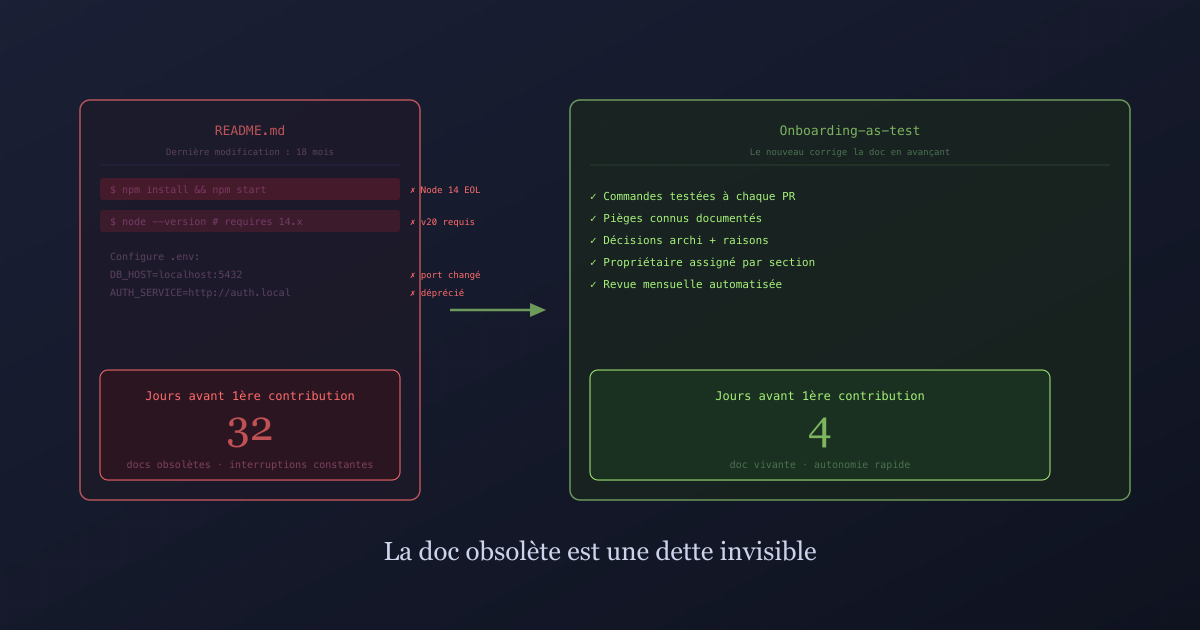
Developer Onboarding: The Real Cost of Outdated Docs
The README says to run 'npm install && npm start'. The command fails with an error about a Node version that's no longer supported. Welcome to the team.
The onboarding documentation is there. It was written eighteen months ago by the lead dev who left the company six months ago. It covers dependency installation, dev environment configuration, project structure, and basic commands.
It’s wrong.
Not entirely wrong: maybe seventy percent of the information is still accurate. But the thirty percent that’s outdated maps exactly to the parts where a new developer will get stuck. The database version changed. The migration command changed. The authentication service now requires local configuration that wasn’t necessary back then. And the repo references an external service that was deprecated and replaced with something else.
Onboarding documentation is a trust trap. It gives the impression that information is available. It consumes the new developer’s time following instructions that don’t work. And it sends an implicit signal about the organization: here, we don’t maintain what we create.
Time to First Contribution
There’s a metric few teams measure but that says a lot about the health of their documentation and onboarding: the time between a new developer’s first day and their first contribution that ships to production.
In teams with carefully maintained documentation and structured onboarding, this metric is on the order of a few days to two weeks.
In teams with outdated documentation and improvised onboarding, this metric is often four to six weeks. Sometimes longer.
The difference isn’t just about the new developer’s productivity. It’s also the signal the process sends: here, getting up to speed takes time, obstacles are many, and you’ll need to ask others a lot.
That last point matters. Outdated documentation forces the new developer to regularly interrupt colleagues with basic questions. Those interruptions have a cost for both parties: they slow down the newcomer, and they fragment the concentration of other team members.
Documentation as Technical Debt
Outdated documentation is a form of technical debt. It has the same properties: it accumulates gradually, it’s invisible until it becomes a problem, and it’s hard to pay down because no one remembers exactly what changed and why.
The difference from classic technical debt: documentation debt has no automatic alarm signal. Code that doesn’t compile immediately signals that it’s broken. Documentation describing an obsolete procedure signals nothing. It silently waits for the next new developer who will try to follow it.
What makes the problem worse: experienced developers on the team don’t see the outdated documentation because they no longer read it. They already know how to do things. Documentation is a tool for newcomers, and newcomers don’t have the context to identify what’s wrong versus what they’re doing wrong.
Why Documentation Degrades
The degradation of onboarding documentation is a near-universal phenomenon. Understanding why helps design a solution.
The lack of feedback loop. When an experienced developer modifies the deployment process, there’s no signal that the onboarding documentation exists and covers that process. The change is made, the code is committed, and the documentation stays behind.
No owner. Onboarding documentation belongs to everyone, which means it belongs to no one. No one is responsible for maintaining it. No one is evaluated on its state. It degrades through inertia.
Asymmetric value recognition. Writing and maintaining documentation isn’t valued in most technical teams. Shipping features is. This imbalance produces documentation that permanently lags behind the reality of the code.
Cultural resistance. In some teams, documenting the obvious is perceived as condescending. “Everyone knows how to run docker-compose.” Yes, now. In six months, when you hire someone from a different background, it may no longer be obvious.
Onboarding as a Documentation Test
A simple but effective practice: treat every onboarding as a test of the documentation.
When a new developer arrives, they shouldn’t need to ask for help on documented steps. If something doesn’t work as described, that’s a documentation bug. Exactly like a bug in the code.
This shift in perspective changes the onboarding dynamic. The new developer is no longer in a failure position when something doesn’t work. They’re finding a bug. And like any bug, their first responsibility is to document it and fix it (or flag what needs to be fixed).
A new developer who spends their first two weeks fixing the onboarding documentation as they go through it themselves produces something doubly useful: they build expertise on the project in the process, and they leave the documentation more accurate than they found it for the person who comes next.
What Onboarding Documentation Should Cover
Most onboarding documentation covers what’s easy to document: setup commands, folder structure, environment URLs.
What they rarely cover, and which is often more useful:
Architectural decisions and the reasoning behind them. Why this framework? Why this particular database structure? Why this external service rather than another? These decisions were made for reasons. A new developer who understands the reasons can work in the spirit of the project, not just by following its forms.
Known pitfalls. Every project has quirks: a configuration that must be done in a specific order, a counter-intuitive behavior from library X, a known bug in the dev environment with a workaround. These pitfalls live in experienced developers’ heads. They’re almost never documented.
The state of technical debt. A new developer who arrives on a codebase with technical debt can spend weeks trying to fix things before realizing it’s intentional (or at least tolerated). Explicitly documenting known areas of technical debt and the reasons they exist avoids this waste.
Implicit conventions. Every team has conventions everyone follows without them being written down: how to name branches, the acceptable size of a pull request, the situations where a comment is preferred over a test. These conventions are passed down verbally, and they’re lost with every departure. Documenting them is the most direct way to preserve them.
Documentation That Maintains Itself
The best-maintained documentation is the documentation in the code.
Automated tests that cover system behavior document what the system does, and they immediately signal when what they document is no longer true. Types in typed languages document interfaces and flag incompatibilities. Commit messages that explain the why (not the what) document the history of decisions.
That kind of documentation doesn’t degrade, or it degrades visibly. It’s maintained by the same discipline that maintains the code.
Prose documentation - READMEs, wikis, onboarding guides - degrades silently. It requires a separate discipline to be maintained.
What made prose documentation expensive to maintain - the time, attention, and context required to know what to update - is changing. Current AI tools make it possible to update an onboarding guide from a diff, verify the consistency between a documented procedure and the actual code, or generate a first draft of documentation from commits and comments. What used to take half a day now takes fifteen minutes. The “we don’t have time to maintain the docs” argument holds less and less water. What remains is a deliberate choice: make it a priority or not.
The solution isn’t to avoid prose documentation. It’s to keep it short, focused on what the code can’t document (the reasons, the pitfalls, the conventions), and to create an explicit process for regular review.
The Signal About Culture
The state of onboarding documentation is a signal about the team’s culture.
A team that maintains accurate onboarding documentation says something about how it thinks about knowledge: it’s a collective asset, not the individual capital of a few experienced people.
A team with outdated documentation says something else: knowledge lives in the heads of veterans, and newcomers must earn their place by finding their way despite the obstacles.
This isn’t a value judgment. It’s an organizational choice with measurable consequences on hiring, retention, and the team’s capacity to absorb growth.
The real cost of outdated documentation isn’t in the time lost following wrong instructions. It’s in the signal it sends: here, you’re on your own. And in what it produces: developers who don’t trust the system, and who end up not trusting the team.
Ready to Transform Your Project Management?
Apply these insights with Sinra - the unified platform for modern teams.
Start Free Trial