 sinra
sinra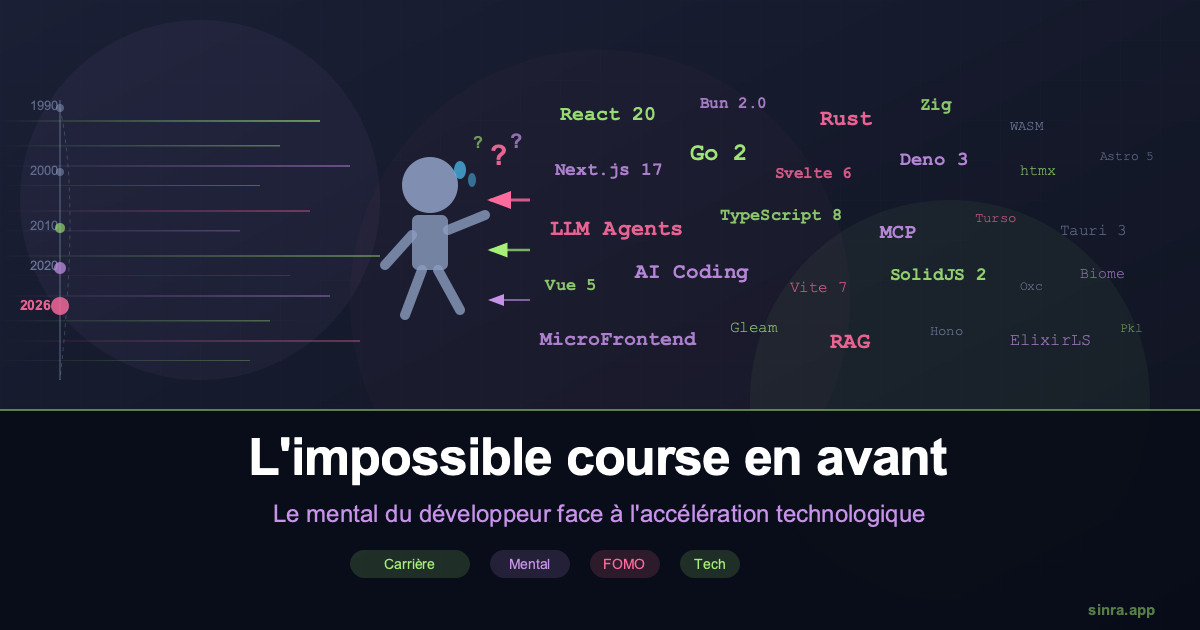
The impossible race: a developer's mindset facing technological acceleration
FOMO, helplessness, fear of missing out... and why it doesn't have to be this way.
Ten years ago, a developer could master their stack and reasonably expect that mastery to stay relevant for five to seven years. Django, Rails, AngularJS, Java enterprise frameworks. You learned, you practiced, you became competent. The mountain was high, but it stayed put.
Today, the mountain moves. Every quarter brings its wave of announced revolutions: a new JavaScript framework that makes the previous one “legacy,” a systems language declaring war on C++, an architectural paradigm that invalidates everything you thought you knew about APIs. And for the past two years, AI has put all of this on steroids.
The result is a particular mental state, quiet but widespread, that many developers will recognize: the permanent feeling of being behind.
What developers actually feel
Opening Hacker News in the morning has become a double-edged exercise. On one side, the intellectual curiosity that led many people into this profession. On the other, a small voice whispering: “That thing, you haven’t learned it yet. Neither have you learned that one. And this other thing just came out and everyone is talking about it.”
This is not laziness, or lack of ambition. It is a rational response to an environment that is objectively irrational in its pace.
The psychological mechanism at work is called FOMO: Fear Of Missing Out. In other contexts, it applies to social events or career opportunities. In tech, it takes a particularly insidious form because it is partially justified. Some technological changes truly matter. The adoption of TypeScript changed the practice of frontend development. Containerization with Docker restructured deployment. The emergence of LLMs is right now redefining what “writing code” means.
The problem is that the brain cannot easily distinguish a genuine revolution from yet another state management framework for React. Both arrive with the same media fanfare, the same enthusiastic LinkedIn posts, the same GitHub stars accumulating at full speed.
Comparing with other disciplines
To measure how strange the situation is for developers, it helps to look at how knowledge behaves in other fields.
A surgeon trained in the 1980s works today with techniques learned forty years ago, refined but not fundamentally overturned. Laparoscopy was a revolution, but it took a decade to establish itself, not six months. The foundations of anatomy, physiology, and sterile technique have not moved.
An automotive mechanic can still practice with skills acquired on internal combustion engines from the 1990s. The electric transition is real, but it unfolds over fifteen to twenty years, with clearly identified phases. There is time to prepare.
An architect relies on structural principles centuries old. Materials evolve, modeling software changes, but the physics of loads and constraints remains what it has always been. An expertise built over twenty years does not become obsolete overnight.
Medicine may be the most striking example. A new treatment only enters clinical practice after five to ten years of studies, validated by peer review, approved by regulatory authorities. The pace of change is slow by design, because the stakes are high.
In software development, none of these protections exist. A framework can go from “industry standard” to “abandoned project” in eighteen months. An architectural paradigm can be unanimously adopted then unanimously criticized over two years. And with generative AI, even what were thought to be foundational skills, writing code, debugging, architecting systems, are being redefined in real time.
Why AI changed the equation
Technological acceleration is not new in computing. Moore’s Law has been a manifestation of it for sixty years. But generative AI introduced something qualitatively different: it accelerates the production of tools that themselves accelerate the acceleration.
In 2022, a developer could reasonably ignore AI tools without it significantly impacting their productivity. In 2024, ignoring GitHub Copilot or Claude Code in certain contexts means accepting a measurable competitive disadvantage. In 2026, the question is no longer “should I use these tools?” but “what is the right way to use them?”, a question whose answer itself changes every three months.
For a developer who was already struggling to keep up with their ecosystem’s evolution, this additional layer can feel like the straw that breaks the camel’s back. Not only must they master their usual tools in a fast-moving context, they also need to understand how AI is transforming them, and how to use them without losing their own reflexes.
The resulting feeling of helplessness is real. It is not a character flaw. It is a normal human response to an environment whose pace of change structurally exceeds individual adaptation capacity.
Distinguishing what matters from what makes noise
The first thing to accept is that the impossibility of keeping up with everything is not personal failure. It is a mathematical property of the situation. There is no developer, however brilliant or disciplined, capable of absorbing in real time everything that comes out in their field. Claiming otherwise is either dishonest or a misunderstanding of what “mastery” means.
This acceptance frees something useful: the ability to choose what to follow and what to let pass, without guilt.
Not all technological changes are equal. Some are structural revolutions that permanently redefine practice. Others are trends, solid for eighteen months then replaced by the next one. The problem is that both arrive with the same media intensity.
A useful signal: ask yourself whether in two years, 70 to 80% of job listings in your sector will mention this technology. Real revolutions always end up embedded in hiring requirements. Trends disappear quietly. TypeScript took four years to go from “interesting Microsoft project” to “de facto prerequisite.” By contrast, how many “revolutionary” JavaScript frameworks of 2019 appear in job listings today?
What languages teach us about longevity
Another lens for taking back control: distinguishing what lasts from what passes.
Languages themselves are remarkably stable. JavaScript has existed since 1995 and remains indispensable for the web. Python is thirty-five years old and has never been more popular. Java, despite thirty years of ritual criticism, runs a considerable fraction of global infrastructure. Go, which appeared in 2009, has become a standard for backend services and system tools.
Frameworks have a much shorter lifespan. Angular replaced AngularJS. React supplanted Angular in many contexts. Vue, Svelte, SolidJS: each generation brings new contenders.
Investing heavily in mastering a framework is a short-term bet. Investing in a deep understanding of a language and its idioms builds foundations that remain relevant for ten to fifteen years. React may be replaced. JavaScript will not be, not anytime soon.
Applied to one’s own learning trajectory, this distinction radically changes the equation. You stop chasing everything that comes out. You choose a domain of lasting excellence, and develop sufficient familiarity with the rest to adapt when a project demands it.
Situated learning rather than anxious accumulation
There is a fundamental difference between learning something because a project requires it and learning something for fear of missing out.
In the first case, learning happens in a concrete context. The problem to solve provides immediate motivation, mistakes have real consequences, retention is far better. You learn Docker by deploying an actual application, not by following a tutorial in a vacuum.
In the second case, learning is anxious, diffuse, often superficial. You spend three hours on a new framework on a Sunday evening, with no real project, driven by a sense of obligation. The following week, you have forgotten most of it. The guilt remains.
The practical rule that follows: do not learn out of FOMO. Learn when a real context demands it. And when it does, commit to it fully, with depth.
A positive note, because it is deserved
The situation is uncomfortable. But it contains something developers often forget in daily pressure: an unprecedented learning opportunity in the history of any profession.
An apprentice carpenter in the Middle Ages spent years perfecting a limited set of techniques passed from master to apprentice. A medical student in the 1960s learned from physical libraries, with limited access to clinical cases and international journals.
Today, a developer who wants to understand the foundations of neural networks can find free university courses, line-by-line annotated implementations, researchers explaining their own papers on YouTube. What would have required a PhD and access to a specialized laboratory is now reachable in a few weeks by anyone motivated.
AI itself, which sits at the heart of the anxiety-inducing acceleration, is also an unprecedented learning tool. Explaining a concept, debugging a line of reasoning, exploring the implications of an architectural decision: questions that would have needed an available senior colleague or hours of research now find answers in minutes.
The solid developer of 2026 is not the one who knows everything. It is the one who chose one or two domains of deep excellence, who knows enough of the rest to adapt when context demands it, and who understood that their job is to solve real problems, not to collect technologies like trading cards.
The race is real. But it does not have to be endured. It can be organized, dosed, directed. And that is precisely where a long and durable career is built.
Writing this article does not fix the problem. But naming it is already a small act of regaining control.
Ready to Transform Your Project Management?
Apply these insights with Sinra - the unified platform for modern teams.
Start Free Trial