 sinra
sinra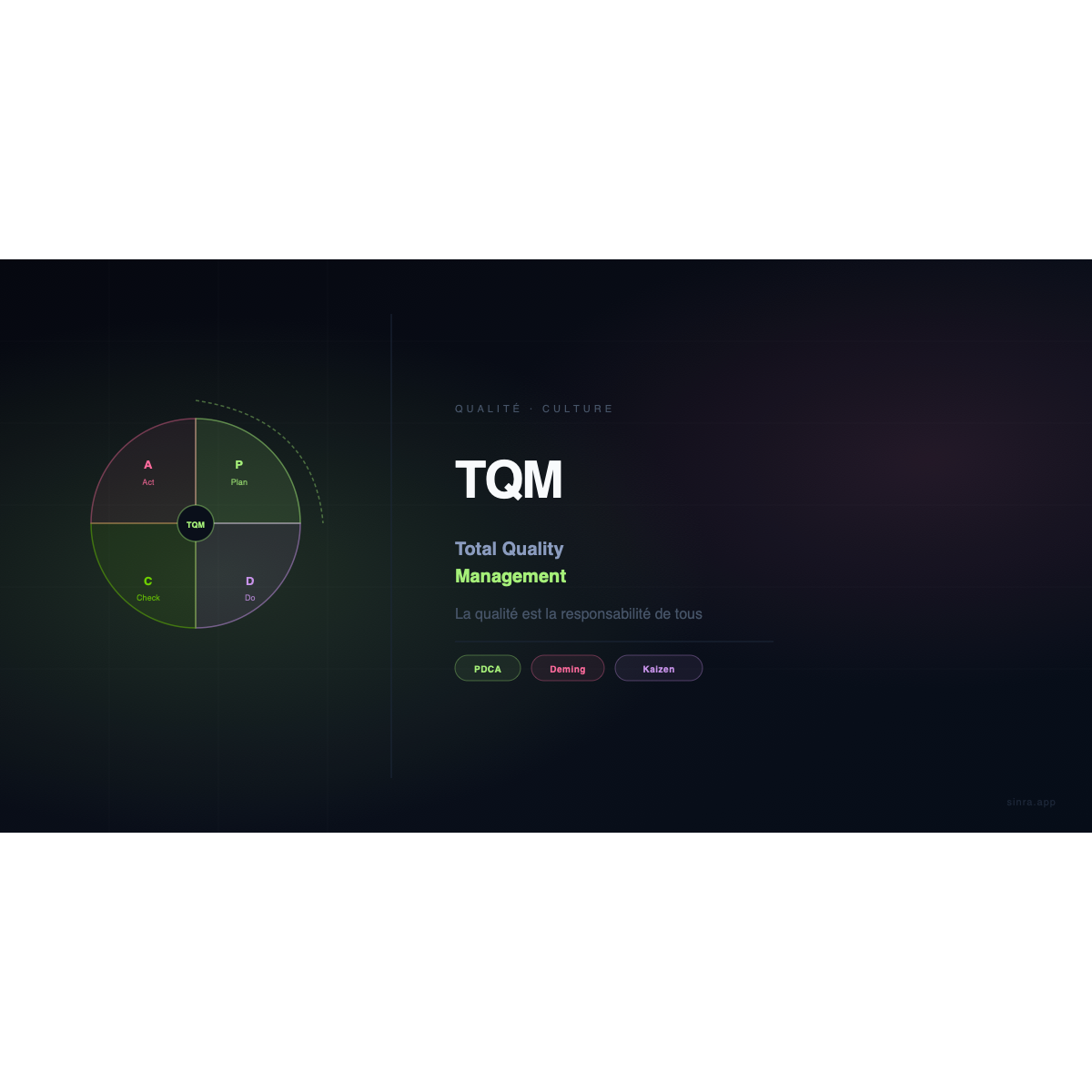
TQM (Total Quality Management): Quality as Everyone's Responsibility
Total Quality Management: when quality is no longer one department's problem but the entire company's responsibility
What is TQM?
Total Quality Management (TQM), or Total Quality Management, is a management philosophy developed in the 1950s-1960s, principally by W. Edwards Deming and Joseph Juran, who applied their theories to post-war Japan. The Japanese economic miracle of the 1970s-1980s is largely attributed to massive adoption of TQM by Japanese industry.
TQM rests on a simple but revolutionary idea: quality is not one department’s job. It is the responsibility of the entire organization.
The Eight Principles of TQM
1. Customer Focus Quality is defined by the customer, not by engineers. All decisions are evaluated for their impact on customer satisfaction.
2. Leadership Management must embody and promote quality culture. Without leadership commitment, TQM remains a communications program.
3. Staff Involvement Every employee is an actor in quality. Ideas for improvement often come from those doing daily work, not managers.
4. Process Approach Quality results from well-defined and controlled processes. Rather than fixing people, we improve processes.
5. System Approach The organization is an interconnected system. Optimizing one part can degrade the whole. Systemic vision is essential.
6. Continuous Improvement Improvement is permanent, not a project with an end. Kaizen (small continuous improvements) manifests this principle.
7. Decision Based on Facts Decisions must be based on measurable data, not intuitions or hierarchies. “In God we trust. All others must bring data.” (W. Edwards Deming)
8. Mutually Beneficial Relationships with Suppliers Quality extends to partners. Quality suppliers produce quality software.
Deming’s 14 Points
W. Edwards Deming, the intellectual father of TQM, formulated 14 points for organizational transformation. The most relevant for software development:
- Eliminate fear: teams that fear punishment for mistakes hide problems. Transparency requires psychological safety.
- Eliminate numerical goals: quotas create counterproductive behaviors (hidden bugs, rushed features to hit metrics).
- Institute leadership: the manager’s role is to help teams work better, not control.
- Continuously improve the system: improvement is an endless process, not a one-time project.
TQM in Software Development
TQM has rich application in software, often without being explicitly named:
Code reviews: collective responsibility for code quality, not just the developer who wrote the line.
Blameless post-mortems: analyze incidents without seeking a culprit. Improve the process that allowed the bug to reach production.
Automated tests: systematic validation processes that do not depend on individual vigilance.
Definition of Done: quality standards everyone understands and respects.
Team retrospectives: improvement forums where the team identifies and resolves its own process problems.
TQM and Sinra
Sinra embodies several TQM principles in its design. The notion of testings as a first-class activity (not an optional add-on) reflects the “quality integrated” philosophy. Customizable statuses allow modeling precise quality processes.
The knowledge base via pages allows capitalizing learning and documenting quality standards shared by the entire team.
TQM vs Six Sigma
TQM and Six Sigma pursue similar objectives but differ in approach:
| Criterion | TQM | Six Sigma |
|---|---|---|
| Focus | Global quality culture | Measurable defect reduction |
| Approach | Philosophical and cultural | Statistical and analytical |
| Responsibility | Entire organization | Certified experts (Black Belts) |
| Measurement | Qualitative + quantitative | Essentially quantitative |
| Timeline | Long term | Defined projects |
Conclusion
TQM is not a method to implement in 3 months. It is a cultural transformation that can take years. But organizations that truly internalize it develop lasting quality resilience that competitors struggle to replicate. In 2026, TQM principles are at the heart of best DevOps practices, “blameless” cultures, and site reliability engineering (SRE).
Ready to Transform Your Project Management?
Apply these insights with Sinra - the unified platform for modern teams.
Start Free Trial