 sinra
sinra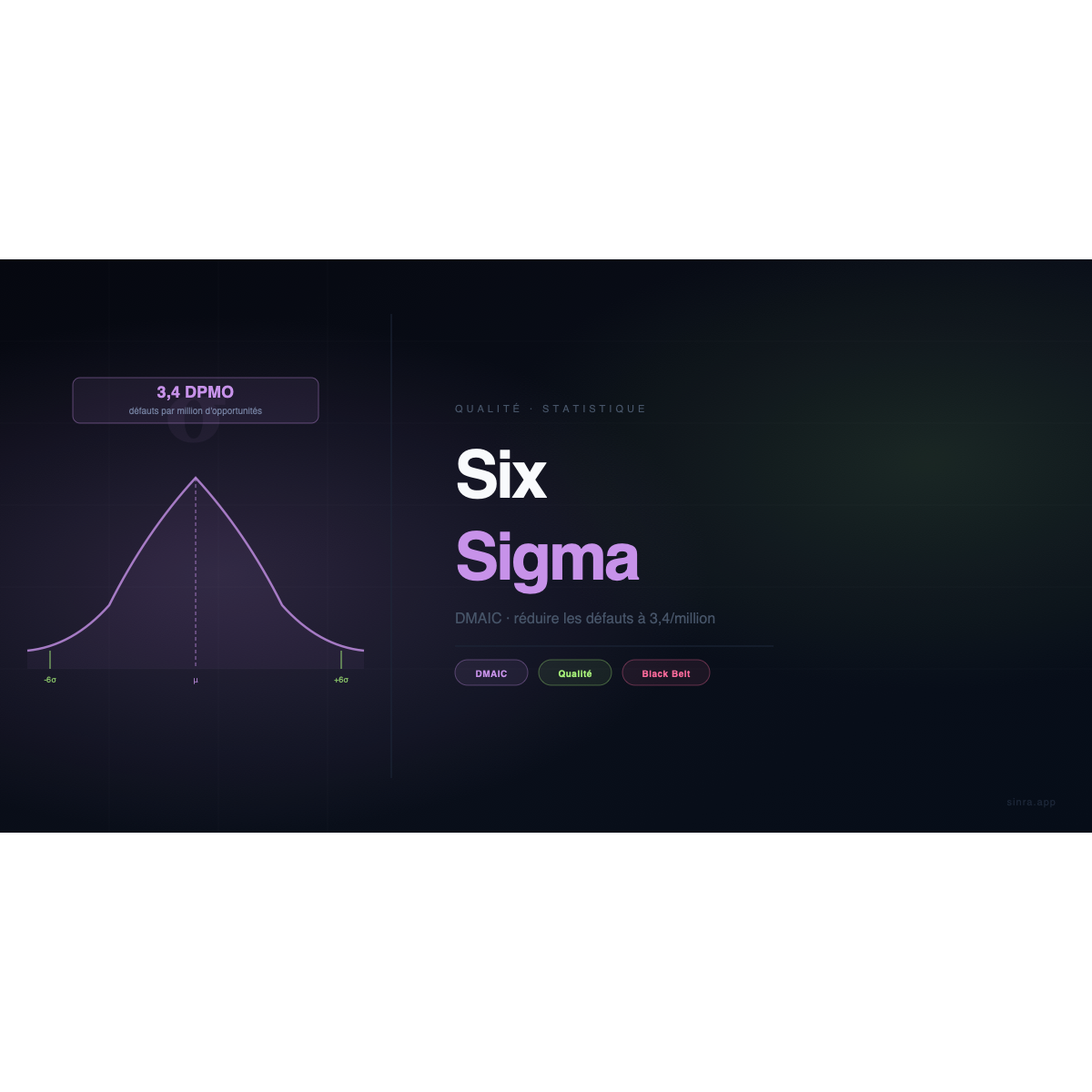
Six Sigma: The Quality Method That Reduces Defects to 3.4 Per Million
DMAIC, DMADV and Six Sigma belts: how General Electric and Motorola revolutionized quality management
The Origin of Six Sigma
Six Sigma is a quality improvement method developed by Motorola in 1986 and popularized worldwide by General Electric in the 1990s under Jack Welch’s leadership. GE claimed to have saved over $10 billion through Six Sigma between 1995 and 2000.
The name comes from the Greek letter sigma (σ), which represents standard deviation in statistics. “Six Sigma” means that the process produces less than 3.4 defects per million opportunities (DPMO). At this level of performance, the process is considered practically defect-free.
The Two Six Sigma Methods
DMAIC: improve an existing process
DMAIC is used to optimize a failing existing process:
- Define: identify the problem, affected customers, objectives
- Measure: quantify current problem, establish baseline
- Analyze: identify root causes through statistical analysis
- Improve: develop and test solutions
- Control: deploy solution and maintain improvements
DMADV: design a new process or product
DMADV (or DFSS - Design for Six Sigma) is used to create a new process aiming for Six Sigma level from the start:
- Define: define objectives and customer needs
- Measure: identify critical characteristics
- Analyze: analyze design alternatives
- Design: create detailed design
- Verify: test and validate design
The Belt Hierarchy
Six Sigma uses a certification system inspired by martial arts:
Yellow Belt: basic Six Sigma knowledge, participation in projects.
Green Belt: capable of leading improvement projects in parallel with their main activity.
Black Belt: expert Six Sigma full-time, manages complex projects, trains Green Belts.
Master Black Belt: senior expert, coaches Black Belts, defines organization’s Six Sigma strategy.
Champion: executive leader who sponsors and promotes Six Sigma in the organization.
Six Sigma and Software Development
Six Sigma was originally conceived for manufacturing processes. Its application to software is possible but requires adaptations:
Direct points of application:
- Reducing production bug rates
- Improving deployment processes (reduce failed deployments)
- Optimizing delivery timelines
- Reducing incident resolution times
Limitations in software:
- Software is not a repetitive production line. Each bug is unique.
- Measuring “defects” is more subjective than in manufacturing.
- Resistance from developers to highly formalized approaches.
Six Sigma and Sinra
Six Sigma concepts apply to measuring development cycle quality in Sinra. Issues provide data to measure defect rate per release. Testings allow tracking QA activities and measuring validation process effectiveness.
DMAIC phases can be modeled as successive cycles of process improvement, each producing measurable quality data.
Most Useful Six Sigma Tools in Tech
- Ishikawa Diagram (Fishbone): identify root causes of recurring bugs
- Control Chart: monitor bug rate stability over time
- FMEA (Failure Mode and Effects Analysis): anticipate system failure modes
- Pareto: identify the 20% of causes explaining 80% of defects
Conclusion
Six Sigma is not the most suited method for agile daily software development. But its tools for statistical analysis of defects, its root cause analysis techniques, and its measurable rigor are valuable for organizations seeking to improve quality systematically and durably. It is a complementary discipline, not a replacement for development methods.
Ready to Transform Your Project Management?
Apply these insights with Sinra - the unified platform for modern teams.
Start Free Trial