 sinra
sinra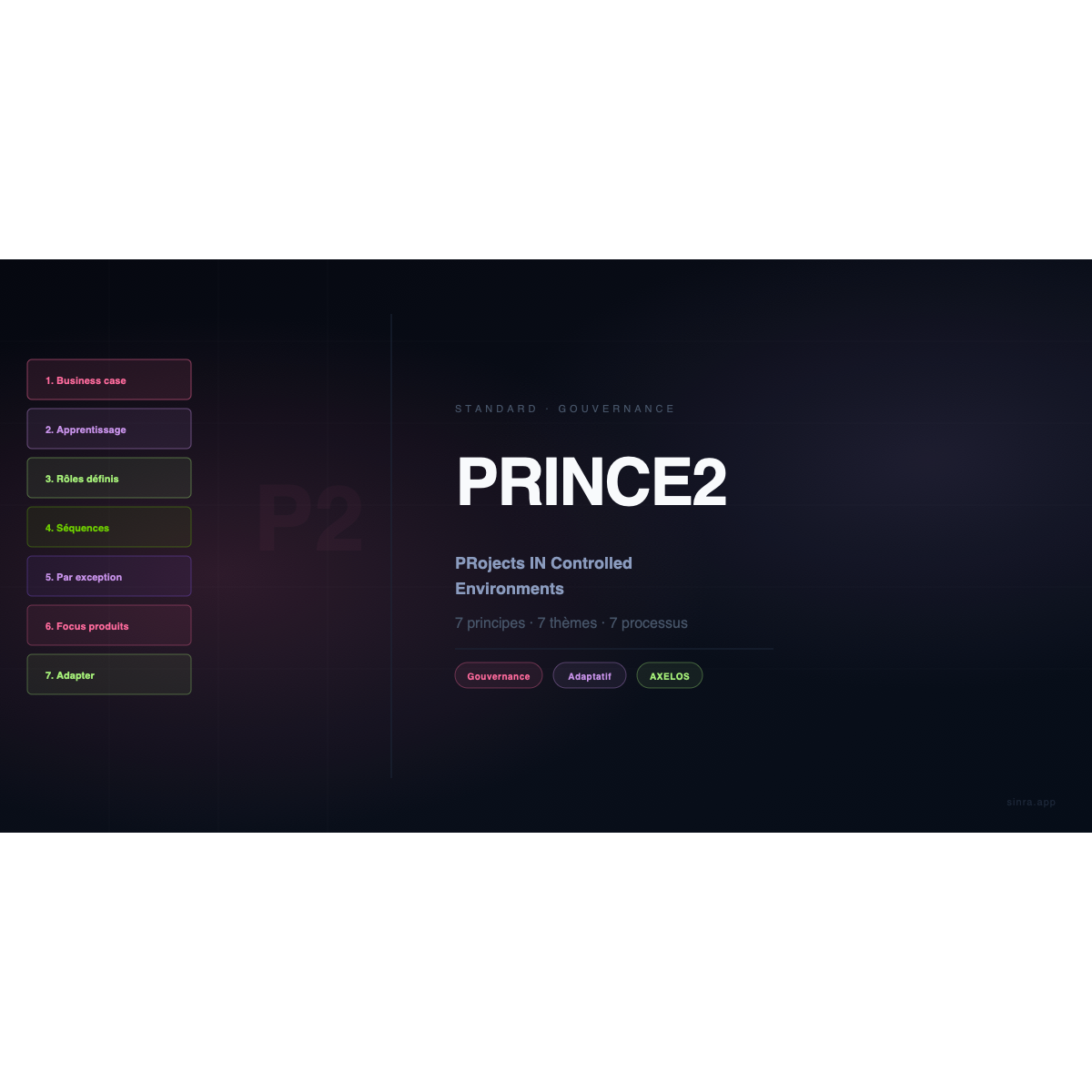
PRINCE2: The British Project Management Standard That Conquers the World
Projects IN Controlled Environments: 7 principles, 7 themes, 7 processes for predictable and governed projects
What is PRINCE2?
PRINCE2 (PRojects IN Controlled Environments) is a project management framework developed by the British government in the 1980s, initially for IT projects in the public sector. It is now maintained by AXELOS (UK government/Capita joint venture) and has become one of the most recognized project management certifications in the world, notably in Europe, Australia, and international organizations.
Unlike PMBOK (American, prescriptive), PRINCE2 is designed to be adapted (tailored) to the size and context of each project. This is its main strength.
The 7 Principles of PRINCE2
The principles are non-negotiable. A project that doesn’t respect these principles is not a PRINCE2 project:
Continued business justification: if the project is no longer worthwhile, it must be stopped.
Learning from experience: lessons are captured, shared, and actively integrated.
Defined roles and responsibilities: each project role is documented with clear responsibilities.
Manage by stages: the project is divided into manageable stages with decision points between each.
Manage by exception: management only gets involved when tolerances (budget, deadline, scope, quality) are exceeded.
Focus on products: PRINCE2 is deliverable-oriented, not activity-oriented. Define what you’ll produce before planning how.
Tailor to the project environment: PRINCE2 must be adapted to the size, context, and sector of the project.
The 7 Themes of PRINCE2
Themes answer the question “What must be continually addressed in a project?”:
- Business Case: why this project? Economic justification is kept current throughout.
- Organization: who does what? Governance structure is defined and respected.
- Quality: what is an acceptable deliverable? Acceptance criteria are defined upfront.
- Plans: how to achieve objectives? Different planning levels (project, stage, team).
- Risk: what uncertainties exist? A risk register is maintained and reviewed regularly.
- Change: how to manage change requests? A change control process is in place.
- Progress: where are we? Advances are measured against the plan.
The 7 Processes of PRINCE2
Processes describe the “when” and “who” of the project:
- Starting up the Project (SU): establish the foundations before starting
- Directing a Project (DP): steering committee decisions throughout
- Initiating a Project (IP): create detailed plans and baselines
- Controlling a Stage (CS): day-to-day delivery management
- Managing Product Delivery (MP): link between project manager and teams
- Managing a Stage Boundary (SB): prepare the next stage
- Closing a Project (CP): formal closure, lessons learned, summary
PRINCE2 Agile: The Fusion
In 2015, AXELOS launched PRINCE2 Agile, an extension that combines PRINCE2 governance with agile practices (Scrum, Kanban, Lean). The idea: apply PRINCE2 rigor to governance and direction, while using Scrum or Kanban for daily team execution.
PRINCE2 and Sinra
PRINCE2 interfaces naturally with Sinra. Releases correspond to deliverables (Product Descriptions) in PRINCE2. Capabilities represent project products. Cycles can correspond to PRINCE2 stages.
Issues track risks and problems the same way the risk register and issue log do in PRINCE2.
Sinra projects meet the “continued business justification” need of PRINCE2: by grouping all planned capabilities in a Gantt view, they allow evaluating at any moment what you want to develop in the future and maintaining the strategic visibility PRINCE2 requires.
PRINCE2 vs PMP/PMBOK
| Criterion | PRINCE2 | PMP/PMBOK |
|---|---|---|
| Origin | British (government) | American (PMI) |
| Type | Prescriptive adaptable framework | Guide to best practices |
| Focus | Governance and control | General project management |
| Sector | Public sector, Europe, Australia | All industries, worldwide |
| Certification | PRINCE2 Foundation/Practitioner | PMP |
Conclusion
PRINCE2 is not the sexiest method, but it’s remarkably effective for organizations that need clear governance, traceability, and predictability. Its flexibility for adaptation makes it relevant for small and large projects alike. In 2026, PRINCE2 Agile makes it compatible with modern development practices.
Ready to Transform Your Project Management?
Apply these insights with Sinra - the unified platform for modern teams.
Start Free Trial