 sinra
sinra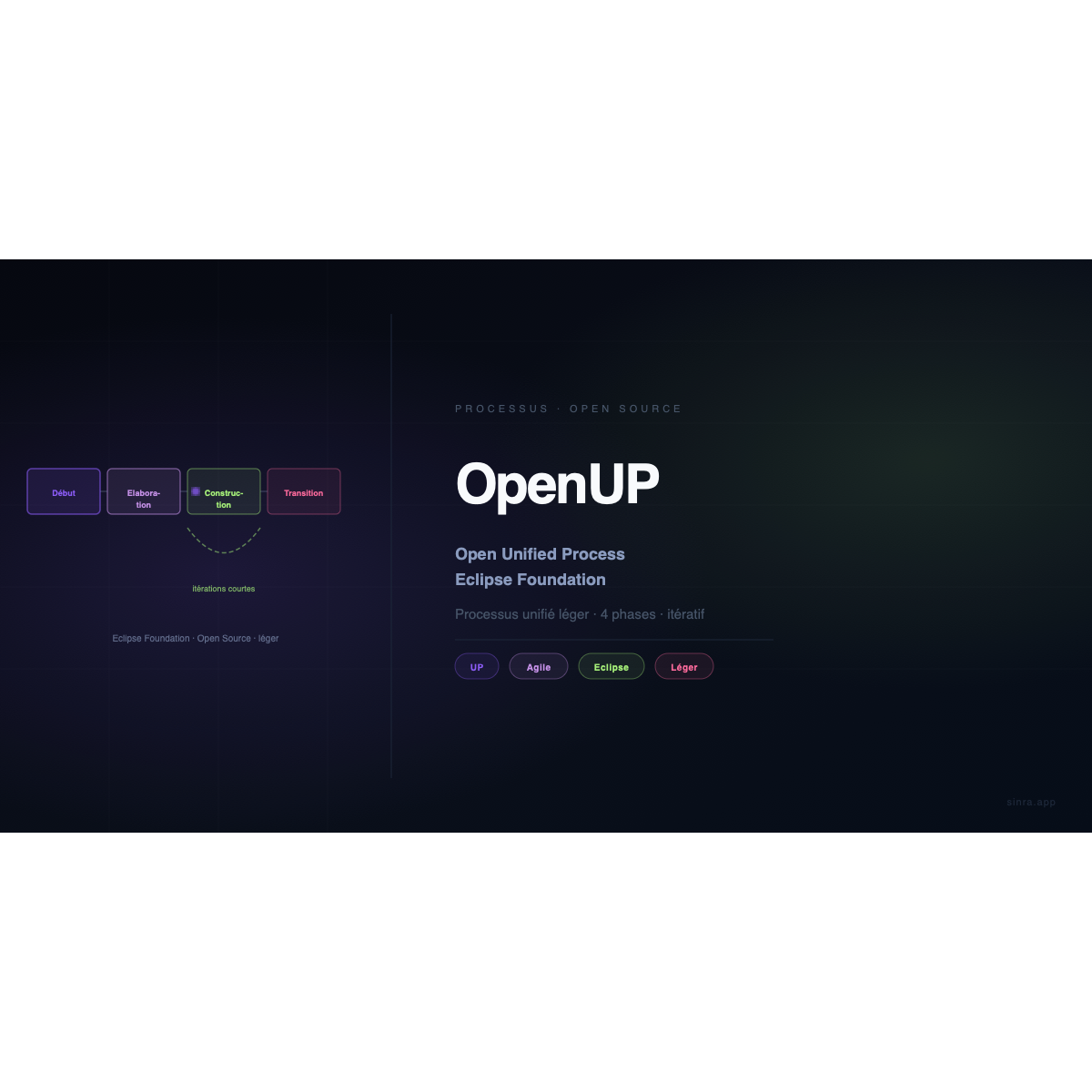
OpenUP: The Light Version of RUP for Modern Teams
Open Unified Process: the minimalist iterative framework combining the best of UP with agile lightness
What is OpenUP?
OpenUP (Open Unified Process) is an iterative, lightweight, open-source software development framework published under Eclipse Public License. Developed by IBM and the Eclipse Process Framework (EPF) community, OpenUP is a minimal instantiation of the Unified Process (UP) that retains essentials while eliminating RUP’s weight.
Where RUP is a complete framework with hundreds of artifacts, roles and customizable practices, OpenUP is “minimalist RUP”: it defines a reduced set of essential practices sufficient for most small-to-medium projects.
OpenUP’s Four Phases
OpenUP retains UP’s 4-phase structure:
Inception (Initialization) Establish project scope and objectives. Identify key stakeholders. Roughly estimate budget and timeline. Assess feasibility. This phase typically lasts 1-2 weeks for a medium project.
Elaboration (Elaboration) Define and stabilize architecture. Develop detailed plan. Identify and mitigate major technical risks. This phase is critical: poor architecture here costs dearly later.
Construction (Construction) Develop product incrementally in several short iterations. Each iteration delivers a testable, potentially deployable increment.
Transition (Transition) Deploy product to production. Train users. Fix bugs discovered in beta. This phase ends when product reaches required quality level.
The 3 Planning Levels
OpenUP defines 3 planning horizons:
Project plan: long-term vision, objectives and major milestones. Updated at each phase start.
Phase plan: defines phase objectives and iterations. Updated at each phase start.
Iteration plan: concrete tasks for the 2-6 week iteration underway. Updated at each iteration start.
This hierarchy provides long-term predictability while allowing short-term adaptation.
OpenUP Roles
OpenUP defines 4 minimal roles:
Analyst: understands and articulates client needs. Manages use cases and requirements.
Architect: defines and maintains architecture. Ensures technical consistency.
Developer: designs, codes, tests. “Developer” in OpenUP includes testing.
Tester: validates system meets requirements. Manages integration and system tests.
Note: one person can play multiple roles. In a small 3-person team, each potentially plays all roles.
OpenUP’s Essential Artifacts
OpenUP reduces artifacts to essentials:
- Vision: 1-3 page document describing problem and proposed solution
- Work backlog: prioritized list of items to develop
- Use Cases: descriptions of user-system interactions
- Architecture Notebook: notes on important architectural decisions
- Iteration plan: current iteration objectives and tasks
- Test Cases: test execution descriptions
No formal business case, no 50-page project plan, no hundreds of UML artifacts.
OpenUP and Agile Practices
OpenUP is compatible with modern agile practices:
- Continuous Integration: automated builds are encouraged
- Test-Driven Development: compatible with XP practices
- Refactoring: maintained as best practice
- Standup meetings: daily meetings recommended during iterations
OpenUP vs Scrum: When to Choose Each?
| Criterion | OpenUP | Scrum |
|---|---|---|
| Structure | Phases + iterations | Sprints only |
| Planning | Multi-level | Backlog + Sprint |
| Architecture | Explicitly managed | Not prescribed |
| Artifacts | Defined (light) | Minimal |
| Process | More structured | More flexible |
| Learning | Moderate curve | Low curve |
Choose OpenUP when:
- Team comes from RUP context and wants progressive transition to lightness
- Project needs explicit architecture attention
- Multi-level planning structure is necessary
- Practitioners have UP/RUP training
Choose Scrum when:
- Team starts without prior UP experience
- Project is purely product, without strong architectural constraint
- Speed of implementation trumps structure
OpenUP and Sinra
OpenUP connects naturally to Sinra. OpenUP phases correspond to Sinra major releases. Iterations correspond to cycles. Use cases and work backlog model as Sinra capabilities and issues.
OpenUP’s Architecture Notebook can live in Sinra pages, centralizing architectural decisions with development tasks in one tool.
The OpenUP project plan, giving long-term vision of objectives and major milestones, translates to Sinra project: a set of capabilities planned across all phases, offering Gantt view of the roadmap without RUP’s documentary weight.
Conclusion
OpenUP is ideal for teams finding Scrum too minimal but RUP too heavy. Its open-source license, clear documentation available on Eclipse Process Framework site, and compatibility with modern agile practices make it a mature, accessible framework. In 2026, OpenUP remains a reference for teams wanting structure and lightness without compromise on essentials.
Ready to Transform Your Project Management?
Apply these insights with Sinra - the unified platform for modern teams.
Start Free Trial