 sinra
sinra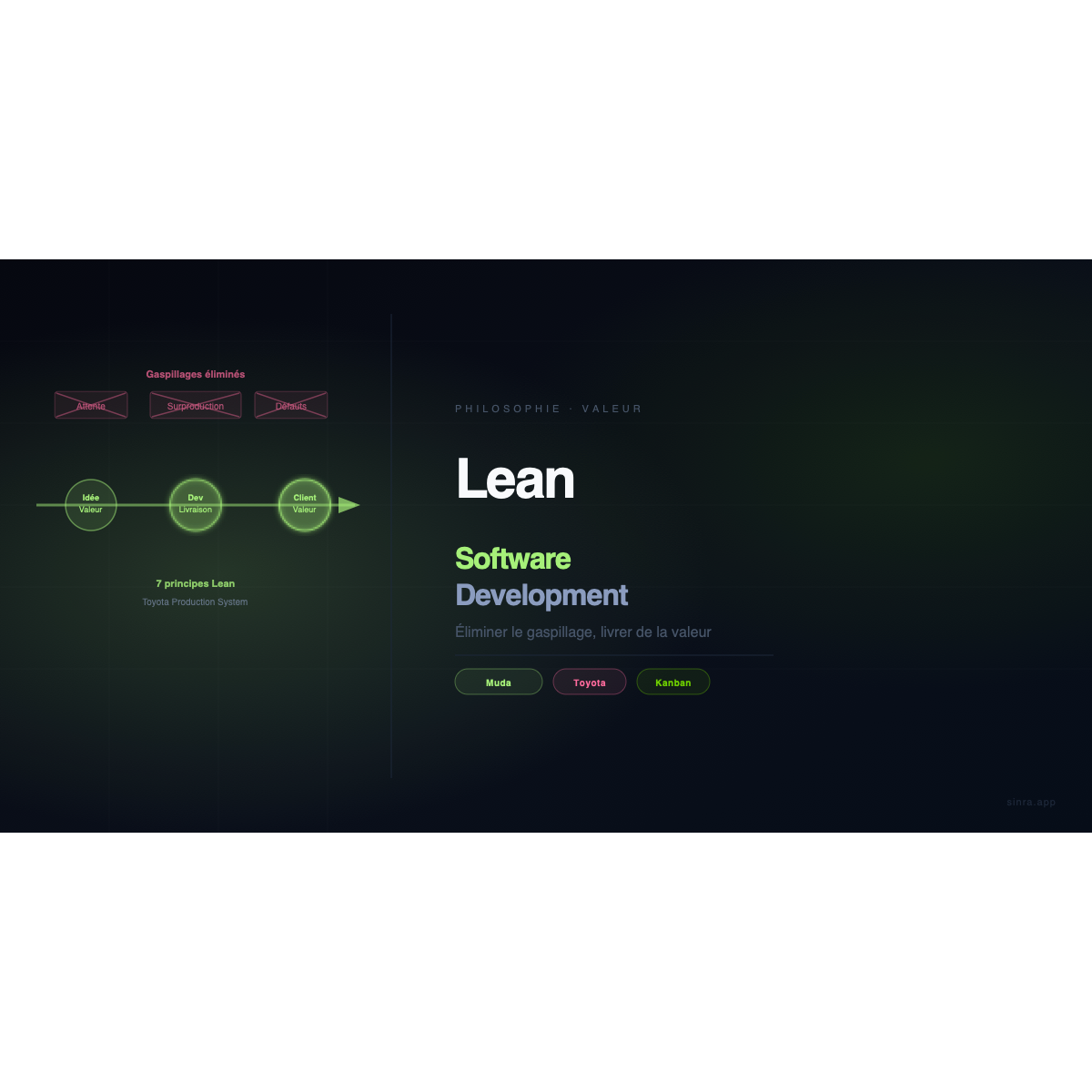
Lean Software Development: Eliminate Waste to Deliver Value
The 7 Lean principles applied to software: from Toyota to your development team
From Lean Manufacturing to Software
Lean Software Development is an adaptation of the principles of the Toyota Production System (TPS) to software development, formalized by Mary and Tom Poppendieck in their 2003 book. The founding idea: if Toyota can eliminate waste in a physical production line to produce faster and better, the same principles apply to software manufacturing.
In TPS, waste (or muda in Japanese) is anything that doesn’t create value for the customer. In software, these are unnecessary meetings, unused features, bugs, waiting, bureaucratic processes.
The Seven Principles of Lean Software Development
1. Eliminate Waste (Eliminate waste) Waste appears in seven forms in software:
- Partially completed code: code not delivered, unmerged branches, features developed but not deployed
- Unnecessary processes: excessive documentation, worthless meetings, bureaucratic approvals
- Unnecessary features: features developed but never used (50-70% according to studies)
- Context switching: constantly moving between tasks reduces productivity by 20-40%
- Waiting: waiting for decisions, reviews, deployments
- Unnecessary movements: searching for scattered information, understanding poorly documented code
- Defects: bugs, regressions, misunderstandings of requirements
2. Amplify Learning (Amplify learning) Software development is a learning process. Rather than planning in detail upfront, Lean encourages rapid experimentation, immediate feedback, and integration of learnings into practice.
3. Decide as Late as Possible (Decide as late as possible) Delay decisions until the last responsible moment, when information is maximized. This is not procrastination, it’s risk management through information.
4. Deliver as Fast as Possible (Deliver as fast as possible) Delivery speed reduces waste related to waiting and enables shorter feedback loops. Lead Time (time between request and delivery) is a key indicator.
5. Empower the Team (Empower the team) Technical decisions must be made by those with expertise, not escalated to distant managers. Self-organized teams make better decisions faster.
6. Build Integrity In (Build integrity in) Perceived integrity (the product does what users expect) and conceptual integrity (architecture is coherent) must be continuous concerns, not end-of-project phases.
7. See the Whole (See the whole) Optimizing each system part can degrade the whole. Lean demands a systemic vision: understand value flows end-to-end.
Lean Tools in Software Development
Value Stream Mapping: map the value flow from idea to production delivery, identify bottlenecks and waste.
Kanban: make workflow visible, limit WIP (Work in Progress) to reduce wait times and context switching.
Kaizen: continuous improvement. Each team regularly identifies and eliminates a source of waste.
5S: workplace organization (adapted as “code organization”: structure, naming, sufficient minimal documentation).
Lean vs Agile: What’s the Difference?
Lean and Agile share close values but differ in approach:
| Criterion | Lean | Agile |
|---|---|---|
| Focus | Eliminate waste | Deliver value quickly |
| Unit | Value flow | Iteration |
| Mechanism | Systemic analysis | Continuous feedback |
| Origin | Manufacturing industry | Software |
| Measure | Lead time, cycle time | Velocity, burndown |
Lean and Sinra
Sinra embodies several Lean principles in its design. The absence of abstract terms (no “epics”, no “user stories”) is a refusal of semantic waste. Issues are concrete work units, capabilities are real features, releases are tangible deliverables.
The visibility of cycles and statuses in Sinra is a direct Lean tool: make the flow visible to identify blockages and reduce wait times.
Conclusion
Lean Software Development is more than a method, it’s a mindset. Asking “does this work create value for the user?” before undertaking it is a transformative habit. Teams that internalize the 7 Lean principles produce faster, with fewer bugs, and with less exhausted teams. In a world where 50-70% of developed features are never used, waste elimination may be the most valuable skill a team can develop.
Ready to Transform Your Project Management?
Apply these insights with Sinra - the unified platform for modern teams.
Start Free Trial