 sinra
sinra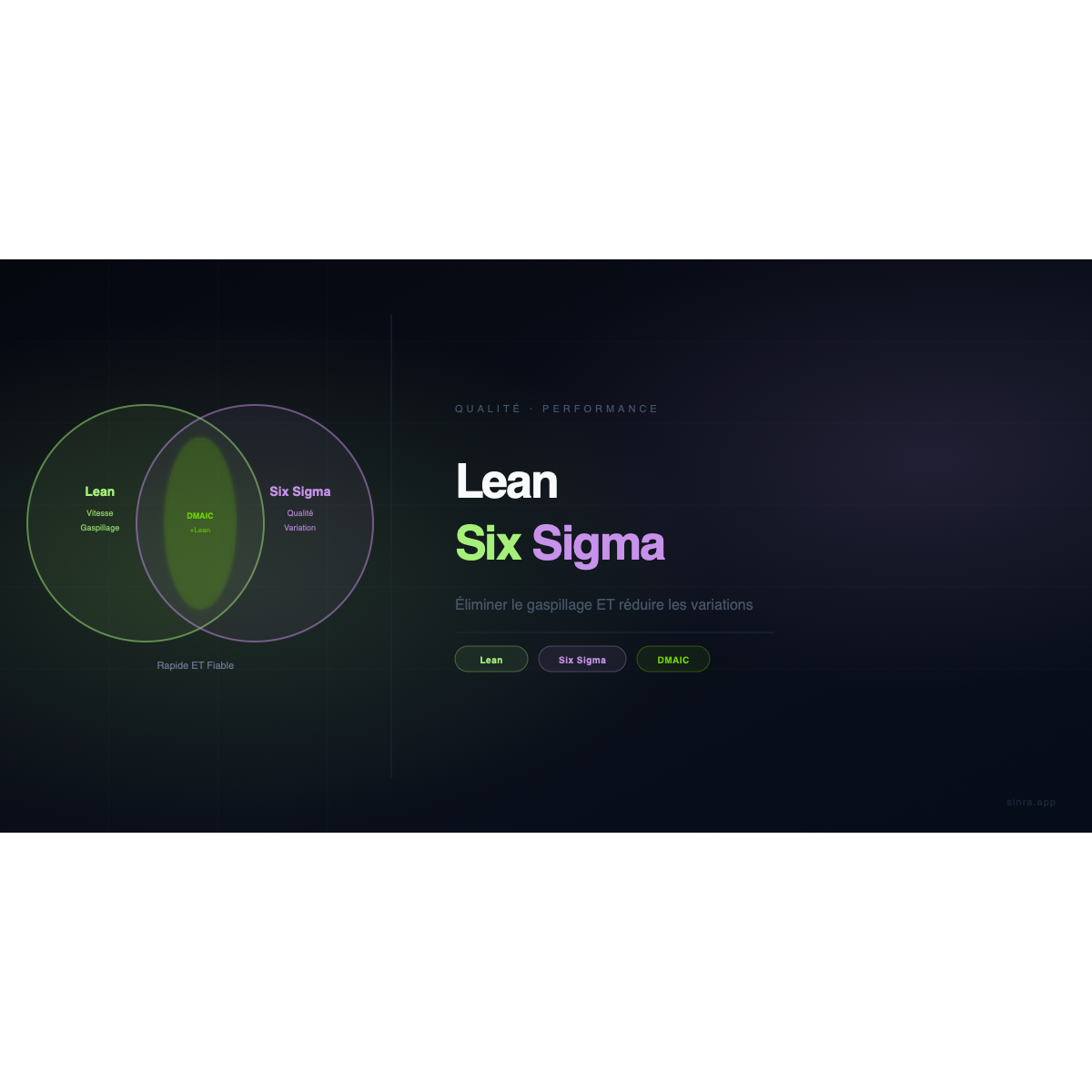
Lean Six Sigma: The Winning Combination Speed + Quality
Lean eliminates waste, Six Sigma reduces variation: together, they transform development processes
Why Combine Lean and Six Sigma?
Lean and Six Sigma were born separately and address different problems:
Lean comes from the Toyota Production System. Its main concern: speed. Eliminate waste (wait times, overproduction, unnecessary movements) so value flows faster from supplier to customer.
Six Sigma comes from Motorola and GE. Its main concern: quality. Reduce variation in processes to produce predictable, near-defect-free results.
Used separately, they each have blind spots:
- Lean can deliver fast… but with variability
- Six Sigma can be very rigorous… but slow due to analytical overhead
Lean Six Sigma combines both for processes that are simultaneously fast AND reliable.
The DMAIC Framework Lean
Lean Six Sigma primarily uses DMAIC (Define, Measure, Analyze, Improve, Control), but enriched with Lean tools:
Define:
- Identify the business problem with Voice of the Customer (VOC)
- Create the Project Charter with scope, objectives and team
- Map current value stream (Value Stream Map)
Measure:
- Collect data on the current process
- Calculate Cycle Time and Lead Time
- Identify bottlenecks with Lean
- Measure process capability with Six Sigma tools (Cp, Cpk)
Analyze:
- Identify root causes of waste and variation
- Distinguish common causes (system noise) from special causes (anomalies)
- Map desired future flows (Future State VSM)
Improve:
- Implement Lean solutions (flow, pull, Kanban)
- Design experiments to validate improvements (DOE - Design of Experiments)
- Deploy changes progressively
Control:
- Implement visual control systems (dashboards, alerts)
- Document new practices (standard work)
- Train the team and monitor indicators over time
Benefits of the Combination
Simultaneous reduction of Lead Time AND defect rate: companies typically report 30-60% reduction in Lead Time and 50-80% reduction in defects in the first years of implementation.
Culture of continuous improvement: Lean Six Sigma is not a project with an end, it’s an organizational culture. Teams develop a reflex for identifying and eliminating problems.
Common language: Lean Six Sigma provides shared vocabulary between technical and non-technical teams to discuss process problems.
Application to Software Development
In a tech context, Lean Six Sigma particularly applies to:
The CI/CD pipeline: reduce Lead Time from commit to production deployment, eliminate flaky tests, stabilize deployments.
The bug resolution process: measure bug reopening rates, reduce mean time to resolution (MTTR).
The development process: map the flow from feature idea to production, identify wait times (code review, approvals, manual testing).
Developer onboarding: reduce the time for a new developer to become productive.
Lean Six Sigma and Sinra
In Sinra, Lean Six Sigma finds its place in analyzing development cycles. Data on issues (resolution time, reopening rate, blockers) provides the raw material for DMAIC analysis.
Testings track QA activities, allowing calculation of defect rate per release and launching targeted improvement cycles.
Who Should Adopt Lean Six Sigma?
Suitable for:
- Organizations with recurring and measurable processes
- Teams that have chronic quality problems or systemic slowness
- Environments that have a culture of measurement and data
Less suitable for:
- Startups in exploration mode (not yet stabilized processes)
- Teams smaller than 10 people (overhead too high)
- Highly creative projects without repeatable processes
Conclusion
Lean Six Sigma is not a miracle solution for all development problems. But for organizations that want to improve simultaneously the speed and quality of their processes systematically and durably, it is one of the most powerful frameworks available. The Lean + Six Sigma combination is more than the sum of its parts: it creates a culture of continuous improvement that durably transforms organizations.
Ready to Transform Your Project Management?
Apply these insights with Sinra - the unified platform for modern teams.
Start Free Trial