 sinra
sinra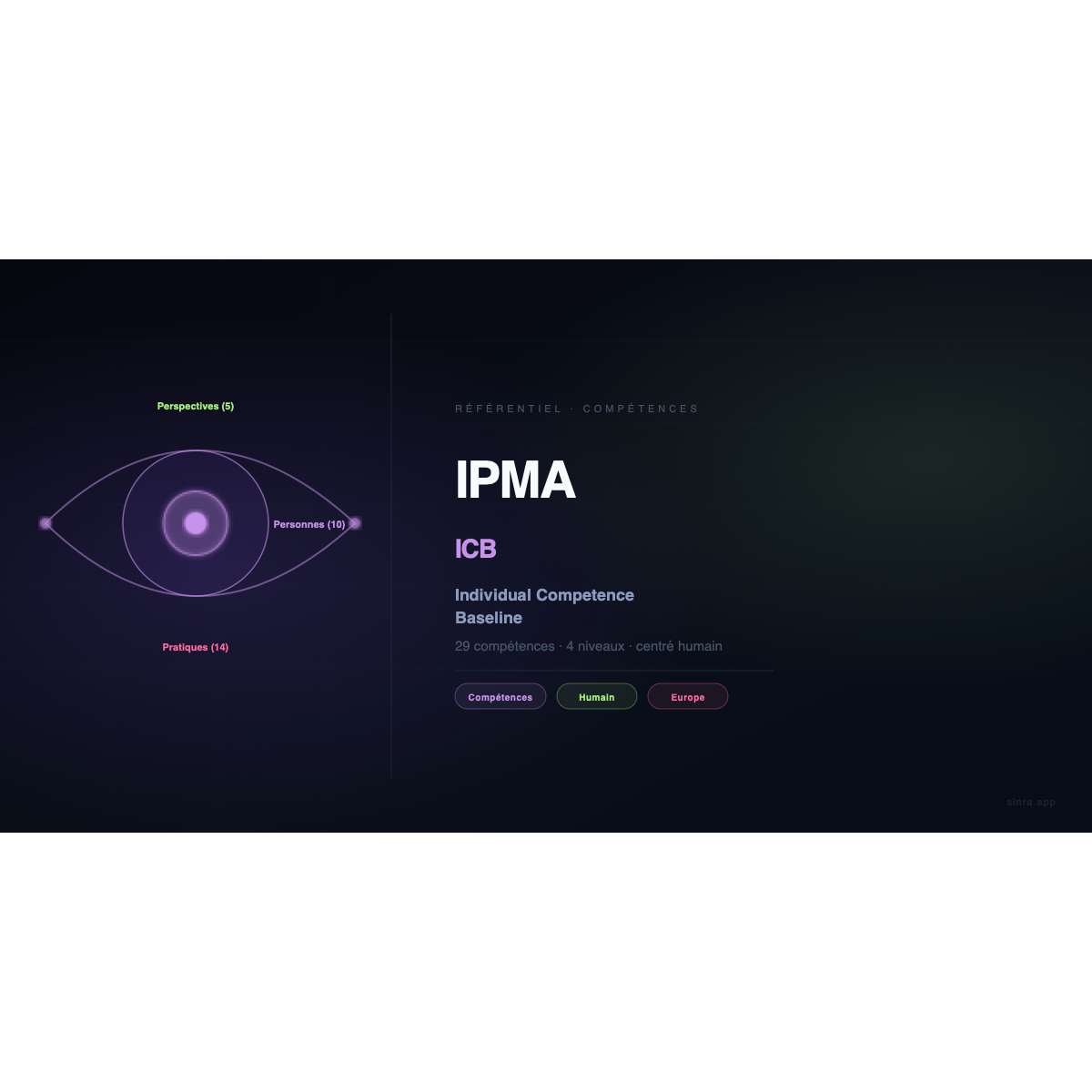
IPMA ICB: The European Project Manager Competency Framework
Individual Competence Baseline: 29 key competencies for project, program and portfolio managers according to IPMA
IPMA and Its Competency Approach
IPMA (International Project Management Association) is an international organization founded in 1965, the oldest in the field. Its ICB (Individual Competence Baseline) framework is at its 4th edition since 2015.
Where PMI (PMBOK) focuses on processes and PRINCE2 on governance, IPMA ICB takes a fundamentally different approach: it focuses on the individual competencies of the professional. The central question is not “What processes to follow?” but “What competencies should a good project manager master?”
The Structure of ICB v4: The Eye of Competence
ICB v4 organizes 29 competencies into 3 domains, visually represented by an “eye”:
Domain 1: Perspectives (5 competencies)
Contextual competencies concerning the environment in which the project takes place:
- Strategy: understand and align the project with organization strategy
- Governance, structures and processes: navigate organizational structures
- Compliance, standards and regulations: manage legal and normative requirements
- Power and interests: understand political dynamics and influence games
- Culture and values: operate in different cultural contexts
Domain 2: People (10 competencies)
Behavioral and interpersonal competencies:
- Self-reflection and self-management
- Personal integrity and reliability
- Personal communication
- Relations and engagement
- Leadership
- Teamwork
- Conflict and crisis
- Resourcefulness
- Negotiation
- Results orientation
Domain 3: Practices (14 competencies)
Technical project management competencies:
- Project design
- Requirements and objectives
- Scope
- Time
- Organization, information and documentation
- Quality
- Finance
- Resources
- Procurement and partnerships
- Plan and control
- Risk and opportunity
- Stakeholders
- Change and transformation
- Selection and balancing
The 4 IPMA Certification Levels
Level D - Associate Project Manager: basic knowledge, no experience required. Ideal for beginners.
Level C - Project Manager: can manage projects of limited complexity. Requires 3 years experience.
Level B - Senior Project Manager: can manage complex projects. Requires 5 years experience with 3 years in responsibility.
Level A - Project Director: can manage major programs or portfolios. Requires 5 years in program/portfolio responsibility.
Assessment combines written exam, project report, and interview with assessors. Unlike PMP (multiple choice), IPMA evaluates actual practice.
What Distinguishes IPMA ICB
Human-centered: the 10 “People” competencies recognize that project success depends more on the human qualities of the project manager than on process mastery.
Contextual: the 5 “Perspectives” competencies recognize that every project occurs in organizational, cultural and political context profoundly influencing its execution.
Qualitative assessment: IPMA assessment evaluates actual practice and maturity, not just memorization of processes.
International: IPMA is present in 70+ countries with national associations (in France: PM France). Certifications are internationally transferable.
IPMA vs PMP vs PRINCE2
| Criterion | IPMA ICB | PMP/PMBOK | PRINCE2 |
|---|---|---|---|
| Focus | Individual competencies | Processes and practices | Governance and method |
| Assessment | Practice + interview | Multiple choice exam | Multiple choice exam |
| Experience required | Yes (except Level D) | Yes | No (Foundation) |
| Recognition | Europe, international | USA, worldwide | UK, Europe, Australia |
| Approach | Competency | Knowledge | Framework |
IPMA ICB and Sinra
IPMA’s competency approach resonates with how Sinra organizes roles and responsibilities. Defining who can do what in a project - who creates releases, who validates capabilities, who closes issues - is a form of competency-based management applied daily.
Conclusion
IPMA ICB is an underestimated framework, particularly relevant for professionals seeking to develop their project management maturity beyond process mastery. Its holistic vision integrating context, human competencies and technical practices is more representative of real project complexity than purely procedural approaches.
Ready to Transform Your Project Management?
Apply these insights with Sinra - the unified platform for modern teams.
Start Free Trial