 sinra
sinra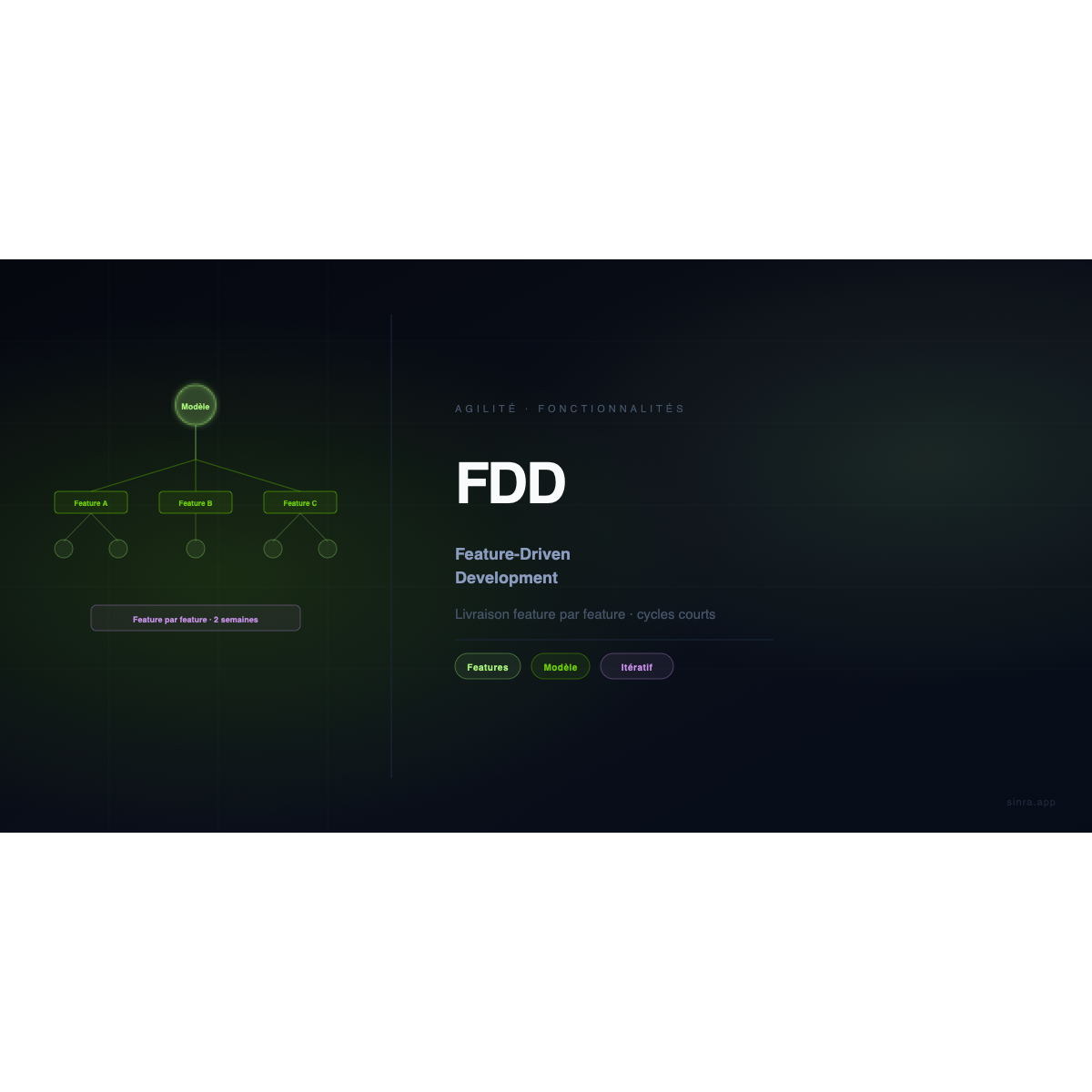
FDD (Feature Driven Development): Deliver Features, Not Processes
Feature Driven Development: the agile method centered on features for large teams
What is FDD?
FDD (Feature Driven Development) is an agile development method created by Jeff De Luca and Peter Coad in 1997 for a banking project in Singapore (150 developers). It is described in “Java Modeling in Color with UML” (1999) and popularized in “A Practical Guide to Feature-Driven Development” (2002).
Its central proposition is simple but powerful: organize all development around short, deliverable features. A feature is defined as “a client-valued action, as small as possible”. The golden rule: a feature must be developable in 2 weeks maximum (ideally 2-5 days).
The 5 FDD Processes
Process 1: Develop an Overall Model A team of domain experts and architects develops a high-level object model of the system. This model guides all future design decisions. It is built in collaborative workshops in 1-2 weeks.
Process 2: Build a Feature List The global model is decomposed into a feature list organized in hierarchy:
- Domain: main business area (e.g. “Customer Management”)
- Activity Set: group of features (e.g. “Create a Customer”)
- Feature: individual feature (e.g. “Create a particular customer account”)
Process 3: Plan by Feature Features are prioritized and assigned to teams. Feature Owners and Class Owners are designated.
Process 4: Design by Feature For each feature group, a Chief Programmer plans a design iteration. The team creates sequence diagrams, detailed design artifacts.
Process 5: Build by Feature Developers implement features per designs created. Each feature goes through code inspection, unit testing, and integration before being marked complete.
FDD Best Practices
FDD defines 6 “best practices” specific to it:
- Domain Object Modeling: model business domain through colored objects (FDD-specific notation)
- Developing by Feature: all development happens in context of a feature
- Individual Class (Code) Ownership: each code class has an owner responsible for it
- Feature Teams: small dynamic teams formed for each feature
- Inspections: formal code reviews per Fagan process
- Regular Builds: regular builds with always-available reference version
- Configuration Management: rigorous version control
- Reporting/Visibility: clear, regular progress reporting
FDD vs Scrum: What’s the Difference?
| Criterion | FDD | Scrum |
|---|---|---|
| Unit of work | Feature (2 weeks max) | User story / Sprint |
| Roles | Architect, Dev Manager, Class Owner, Feature Owner, Domain Expert | Product Owner, Scrum Master, Dev Team |
| Planning | Long term possible (complete feature list) | Progressive backlog |
| Team size | Scalable (large teams) | Small teams (5-9) |
| Modeling | UML + Domain Modeling | Rare, often informal |
| Documentation | Domain model | User stories |
FDD for Large Teams
FDD is one of the rare agile methods explicitly designed for large teams (50-200+ developers). Where Scrum recommends teams of 5-9 (and uses Scrum of Scrums for scaling), FDD natively organizes work for large teams through its domain/activity set/feature hierarchy.
FDD and Sinra
The FDD hierarchy (domain, activity set, feature) maps naturally to Sinra structure. Capabilities correspond to FDD Activity Sets, issues to individual features. Releases group completed features, and cycles correspond to Design and Build iterations per feature.
FDD’s “Class Owner” notion resonates with roles and assignments in Sinra, where each issue can have a clearly designated owner.
The FDD Feature List, built in phase 2 as complete catalog of all features to develop, corresponds precisely to a Sinra project: a set of capabilities organized in Gantt view giving long-term visibility on everything the team wants to build, before development cycles even start.
Conclusion
FDD is an underestimated agile method, particularly for organizations managing large teams needing more structure than Scrum without RUP’s weight. Its strict feature definition (deliverable in 2 weeks maximum) is a helpful discipline forcing teams to decompose work into tangible, measurable units.
Ready to Transform Your Project Management?
Apply these insights with Sinra - the unified platform for modern teams.
Start Free Trial