 sinra
sinra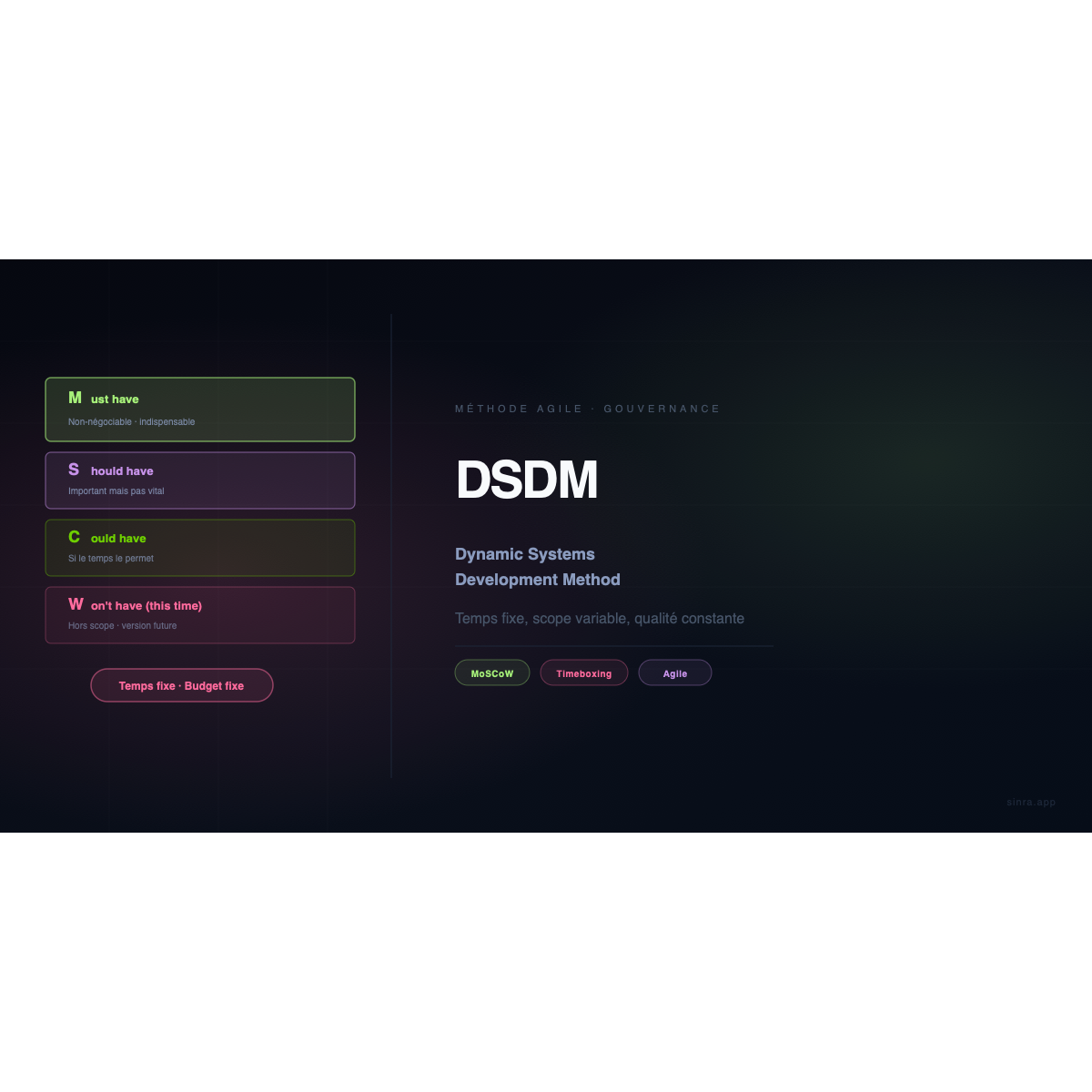
DSDM (Dynamic Systems Development Method): Agility With Guardrails
DSDM: the British agile framework that fixes time and budget, but lets scope vary
What is DSDM?
DSDM (Dynamic Systems Development Method) is an agile framework developed in the United Kingdom in 1994 by the DSDM Consortium, a group of practitioners and organizations seeking a structured alternative to RAD.
Its central value proposition is radical: a project’s time and budget should not be variables, they are constants. What varies based on reality is the scope. This inversion of the classic project management triangle (scope-timeline-cost) is DSDM’s philosophical core.
DSDM is often classified as an agile method, but it stands out through its formal structure and defined processes, making it more hybrid than purely agile.
The Eight Principles of DSDM
DSDM rests on eight non-negotiable principles:
Focus on business needs: each decision is evaluated for business value, not technical criteria.
Deliver on time: deadlines are sacred. We reduce scope rather than delay.
Collaborate: customers, users and developers work together as an integrated team, not in silos.
Never compromise on quality: the quality level is defined at project start and never decreases, even under pressure.
Build incrementally on solid foundations: each increment is stable and usable. No accumulated technical debt.
Develop iteratively: continuous feedback refines understanding and improves the product.
Communicate continuously and clearly: information flows freely and explicitly, not through email or late documentation.
Demonstrate control: the project is always visible and controlled through clear indicators.
The DSDM Lifecycle
DSDM defines a structured lifecycle in several phases:
Pre-project: initial feasibility study, appropriate project selection.
Foundations: understand high-level needs, define basic architecture, plan the project.
Exploration: refine and develop priority features in iterations.
Engineering: develop, test and integrate retained features.
Deployment: deliver system to users, obtain formal approvals.
Post-project: assess realized benefits and identify lessons learned.
The MoSCoW Priority
DSDM popularizes the MoSCoW prioritization technique, still widely used today:
- Must have: non-negotiable features. Without them, the product cannot function.
- Should have: important but not vital for initial version.
- Could have: desirable if time permits.
- Won’t have (this time): explicitly out of scope for this version.
This hierarchy allows structured scope reduction when the deadline approaches, without creating confusion about priorities.
DSDM Strengths
Predictability: delivering on time is a kept promise. Stakeholders know when they will get something.
Formal governance: DSDM has defined processes, clearly delimited roles, and checkpoints. It suits organizations needing structure.
Non-negotiable quality: unlike some agile methods where quality is sometimes sacrificed for speed, DSDM protects it explicitly.
Risk management: incremental delivery reduces the risk of losing everything if the project drifts.
DSDM Limitations
User availability: DSDM requires intensive end-user participation. Without them, the process breaks down.
Implementation complexity: DSDM is more structured than Scrum or Kanban. AgilePM certification (based on DSDM) testifies to this complexity.
Less known: compared to Scrum, DSDM is less widespread outside the UK and organizations that adopted AgilePM.
Deadline rigidity: the “deliver on time or reduce scope” principle can create tension if minimum viable scope is insufficient.
DSDM and Sinra
Sinra is inspired by certain DSDM principles: time-boxed cycles, incremental delivery, continuous collaboration. But Sinra takes a different position on one fundamental point: MoSCoW prioritization.
In Sinra, when a task enters a cycle, it’s because it was deliberately chosen and planned. By default, each issue has its importance and must be completed. There is no room for “Should have” or “Won’t have” within a cycle: if a task is not priority, it doesn’t enter the cycle in the first place.
This philosophy avoids the MoSCoW trap where “Could have” features accumulate indefinitely at the bottom of the list without ever being handled or officially abandoned. In Sinra, the decision is made before the cycle, not during: either a capability joins the release, or it waits. Once committed, it is completed.
Sinra projects precisely answer the need for long-term visibility that MoSCoW tries to satisfy: by grouping future capabilities in a project, you get a Gantt-like view of what you want to develop, without having to prioritize in-progress tasks with floating priority labels.
Conclusion
DSDM is a mature, structured framework bringing discipline that some agile methods do not provide. Its central principle, fixing time and letting scope vary, is a pragmatic answer to project reality. In 2026, DSDM is the foundation of AgilePM certification, popular in organizations seeking agility with formal guardrails.
Ready to Transform Your Project Management?
Apply these insights with Sinra - the unified platform for modern teams.
Start Free Trial