 sinra
sinra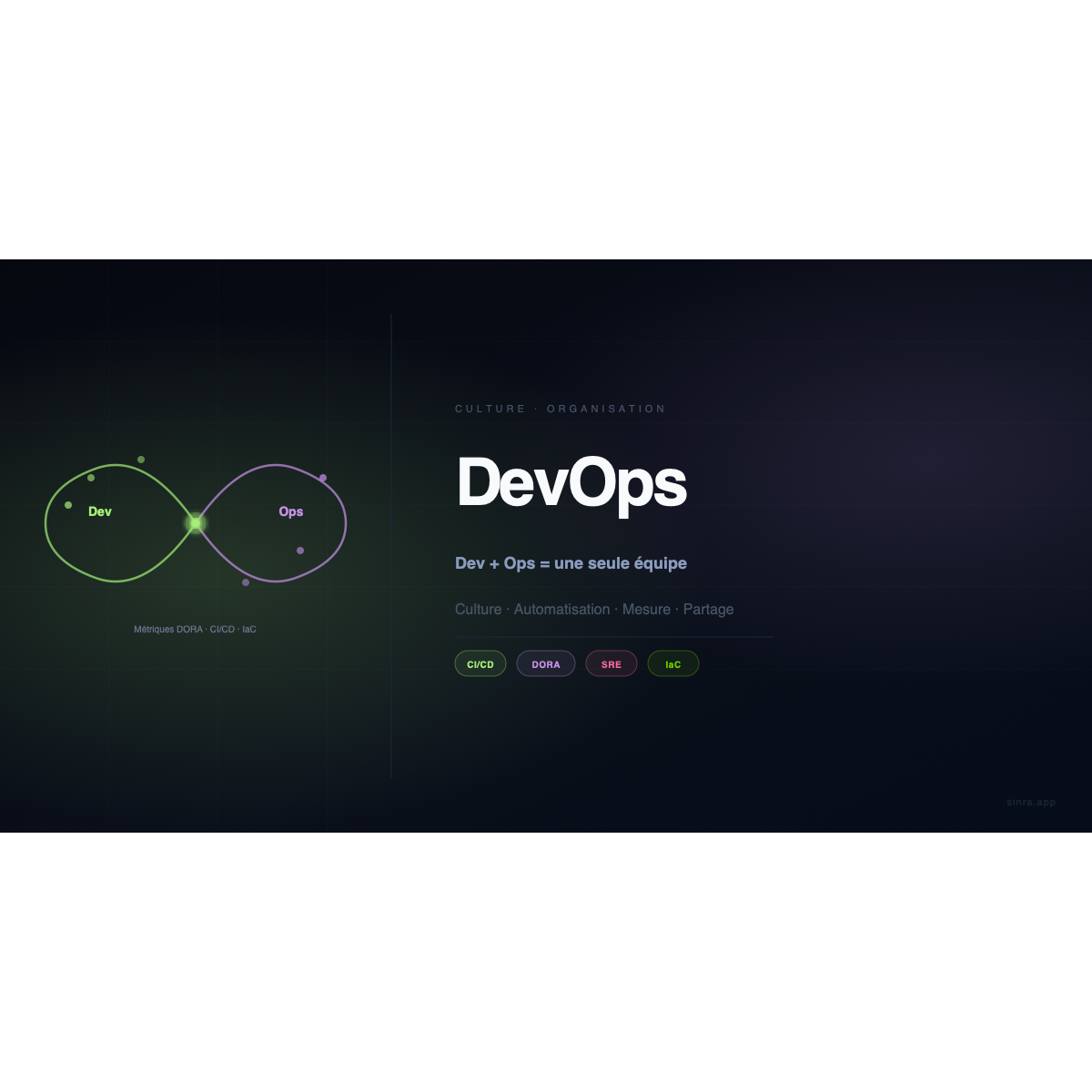
DevOps: When Development and Operations Finally Work Together
Culture, automation, measurement, and sharing: the 4 DevOps pillars that transformed the software industry
The Origin of DevOps
DevOps is a movement born in 2008-2009, officially launched at the first DevOpsDays in Ghent, Belgium by Patrick Debois. The term fuses “Development” and “Operations” and symbolizes the end of a fratricidal war that was costly to the software industry.
Before DevOps, development teams and operations teams (Ops) had contradictory objectives. Devs wanted to deliver fast and change often. Ops wanted stability and resisted change. The result: rare deployments, painful ones, and often catastrophic.
DevOps changed this dynamic by starting from a simple observation: these teams must share objectives, responsibility, and tools.
The 4 Pillars of DevOps Culture (CAMS)
The CAMS framework by Damon Edwards summarizes the DevOps culture:
C - Culture Mindset change takes priority over tools. Dev and Ops teams share responsibility for production incidents. “You build it, you run it” (Werner Vogels, Amazon).
A - Automation Automate everything that can be automated: tests, deployments, infrastructure (Infrastructure as Code), monitoring. Automation frees humans from repetitive tasks and eliminates manual errors.
M - Measurement Measure to improve. DORA metrics (see below) became the standard for measuring DevOps performance.
S - Sharing Share knowledge, tools, responsibilities. Blameless post-mortems, public runbooks, and shared Dev/Ops tools are concrete manifestations.
DORA Metrics: Measuring DevOps Performance
The DORA (DevOps Research and Assessment) program from Google identified 4 key metrics that distinguish elite teams from struggling ones:
Deployment Frequency (deployment frequency): how often are we deploying to production? Elite teams deploy multiple times per day.
Lead Time for Changes (change delivery time): how much time between a commit and a production deployment? Elite teams: less than one hour.
Mean Time to Recovery (mean recovery time): how long to restore service after an incident? Elite teams: less than one hour.
Change Failure Rate (deployment failure rate): what percentage of deployments cause an incident? Elite teams: 0-15%.
Essential DevOps Practices
CI/CD (Continuous Integration / Continuous Delivery) Every commit triggers an automated pipeline: tests, build, quality analysis, deployment. The goal: reduce Lead Time and deployment size.
Infrastructure as Code (IaC) Infrastructure is defined in versioned code (Terraform, Ansible, Pulumi). Environments are reproducible and consistent. Configuration drift is eliminated.
Monitoring and Observability Metrics, logs, distributed traces. DevOps teams see what’s happening in production and respond before users report problems.
Feature Flags Deploy code without activating it. Progressively activate for a subset of users. Disable immediately if problems arise. Decouple deployment from production.
Blameless Post-mortems Analyze incidents without looking for a culprit. The goal is to understand the system and improve processes. Psychological safety is fundamental.
DevOps and Sinra
DevOps and Sinra complement each other naturally. Sinra’s issues track infrastructure, deployment, and operations tasks just like development tasks. Sinra’s releases correspond to deployment milestones, and cycles to DevOps sprints.
The notion of capabilities in Sinra allows describing infrastructure and automation improvements at the same level as product features, normalizing the visibility of DevOps efforts.
DevOps vs SRE
SRE (Site Reliability Engineering, Google) is a specific implementation of DevOps. Where DevOps is a culture, SRE is an engineering practice with concrete methods: SLO, SLI, error budgets, toil reduction.
Conclusion
In 2026, DevOps is no longer optional for product teams: it’s the standard. Organizations that haven’t adopted CI/CD practices, Infrastructure as Code, and a culture of shared responsibility find themselves structurally slower than their competitors. DevOps isn’t an expensive investment: it’s competitive survival.
Ready to Transform Your Project Management?
Apply these insights with Sinra - the unified platform for modern teams.
Start Free Trial