 sinra
sinra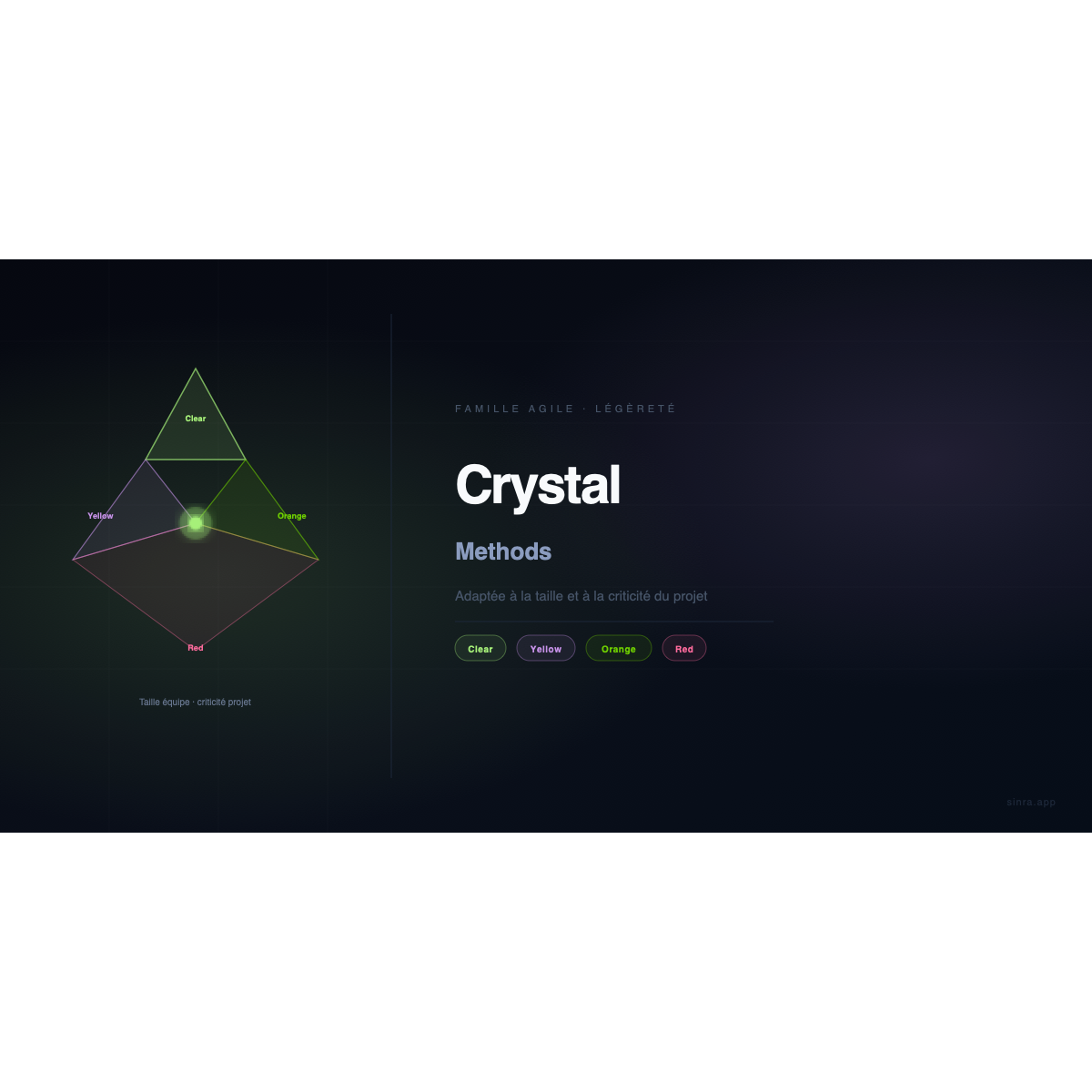
Crystal Methodology: Agility That Adapts to Your Project's Size and Risk
Crystal Clear, Crystal Yellow, Crystal Orange... The family of methods by Alistair Cockburn that calibrates agility to context
Cockburn’s Idea: Method Depends on Context
Crystal Methods is a family of agile methods created by Alistair Cockburn in the 1990s. Cockburn, one of the 2001 Agile Manifesto signatories, started from a fundamental observation: there cannot be a single optimal method for all software projects.
A 3-person project working on internal tools doesn’t have the same needs as a 100-person project working on a critical banking system. Forcing both into the same methodological framework is absurd.
Crystal proposes a family of methods named after precious stones according to their “weight”: the harder the stone, the heavier the method.
The Crystal Family Members
Crystal methods are differentiated on two dimensions:
Axis 1: Team Size
- Crystal Clear: 1-6 people
- Crystal Yellow: 7-20 people
- Crystal Orange: 21-40 people
- Crystal Red: 41-80 people
- Crystal Maroon: 81-200 people
- Crystal Diamond / Sapphire: 201+ people (very high criticality)
Axis 2: Criticality (impact of a bug)
- C (Comfort): minor inconvenience
- D (Discretionary Money): recoverable money loss
- E (Essential Money): non-recoverable money loss
- L (Life): human life risk
Crystal Clear: The Best Known
Crystal Clear is the best documented and most used variant. It addresses 2-6 person teams on a single site, working on D or E criticality projects.
Its 7 basic properties:
- Frequent delivery: deliver to real users every 1-3 weeks
- Reflective improvement: team regularly improves via retrospectives
- Osmotic communication: team members naturally overhear each other’s discussions
- Personal safety: freedom to speak without fear
- Focus: each developer knows what to work on, has uninterrupted time
- Easy access to expert users: users available to answer questions
- Technical environment: automated tests, continuous integration, version control
Two optional properties (for E criticality): personal synchronization and interaction coherence.
Common Crystal Principles
All Crystal methods share fundamental principles:
Method must be light: the process must be as light as possible while remaining safe.
People are central: Crystal believes quality people can compensate for imperfect processes, but good processes can’t compensate for poor people.
Reflectivity and adaptation: all Crystal methods include mechanisms for the team to improve continuously.
Direct communication preferred: Crystal prefers face-to-face communication to documentation.
Crystal vs Scrum vs XP
| Criterion | Crystal Clear | Scrum | XP |
|---|---|---|---|
| Team size | 2-6 | 5-9 | 2-12 |
| Formalism | Very light | Moderate | Moderate |
| Technical practices | Non-prescribed | Non-prescribed | Yes (TDD, pair prog) |
| Scalability | Entire family | Scrum of Scrums | No |
| Location | Co-location preferred | Flexible | Co-location preferred |
Crystal Methods and Sinra
Crystal’s philosophy of calibrating the process to context is at the heart of Sinra’s design. Sinra doesn’t force a single method: cycles can last 1 week or 6 weeks, releases can be weekly or quarterly.
Customizable statuses allow modeling any Crystal workflow without imposing Scrum or Waterfall vocabulary.
Why Crystal Is Underestimated
Crystal never achieved Scrum or XP popularity, partly because Cockburn deliberately avoided commercializing the method and creating a certification industry around it. Irony: the method that best recognizes context diversity is the one that didn’t try to impose itself universally.
Conclusion
Crystal Methods brings maturity that many agile methods lack: recognition that “the best method” is nonsense outside specific context. For teams wanting pragmatic, context-suited agility, Crystal Clear remains one of the most honest references available.
Ready to Transform Your Project Management?
Apply these insights with Sinra - the unified platform for modern teams.
Start Free Trial