 sinra
sinra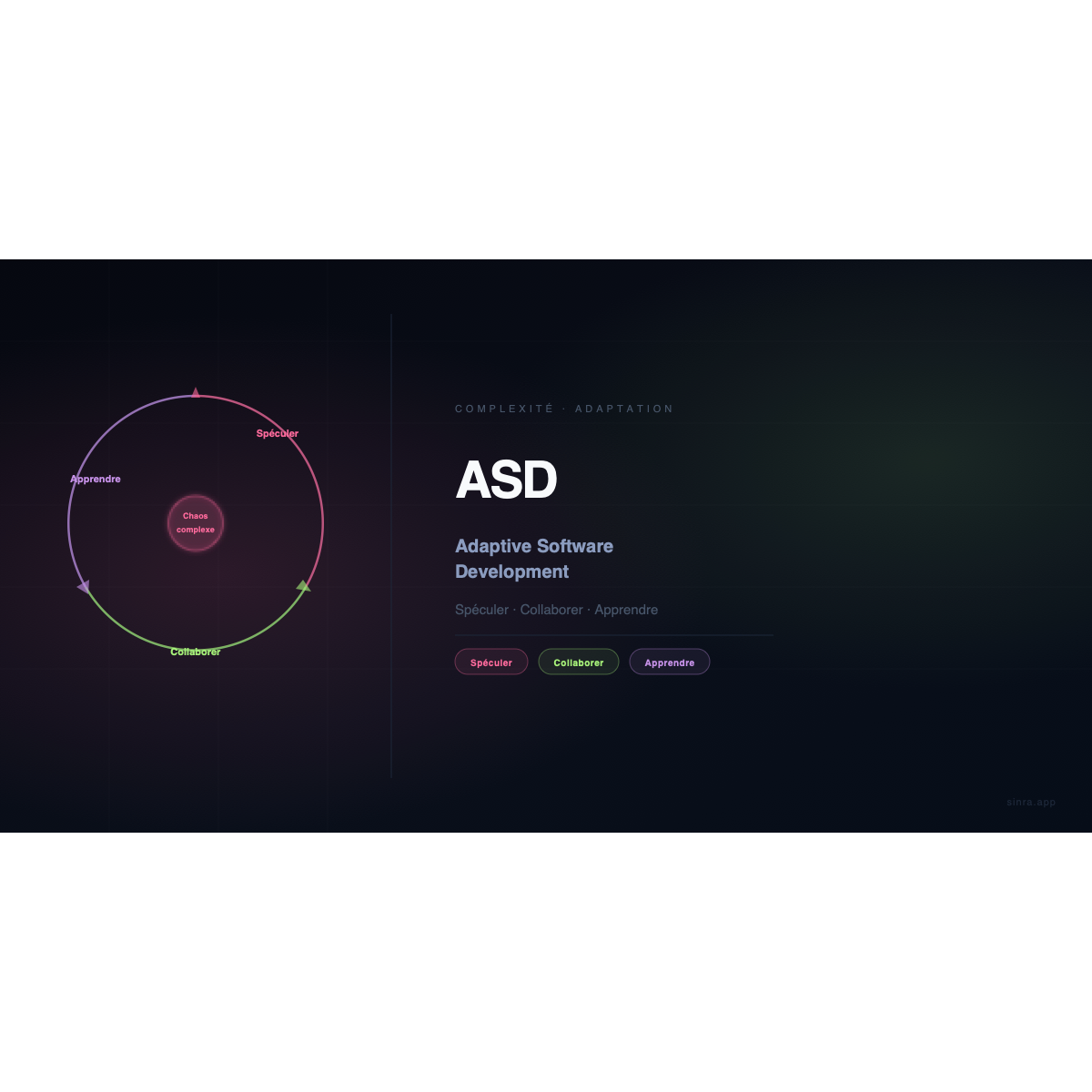
ASD (Adaptive Software Development): Manage Uncertainty by Design
Adaptive Software Development by Jim Highsmith: speculate, collaborate, learn to navigate complex projects
The Origin of ASD
ASD (Adaptive Software Development) is an agile method created by Jim Highsmith and Sam Bayer, described in the book “Adaptive Software Development: A Collaborative Approach to Managing Complex Systems” (2000). Jim Highsmith is also one of the signatories of the 2001 Agile Manifesto.
ASD is born from frustration with traditional methods that assume detailed planning of complex projects is possible. Highsmith turned to complex adaptive systems theory (Complex Adaptive Systems, CAS) to find a more realistic model.
His thesis: software projects behave like complex systems, not mechanical ones. You can’t plan them; you can only adapt to them.
The ASD Cycle: Speculate, Collaborate, Learn
Where Waterfall uses “Plan, Develop, Test”, ASD deliberately proposes different vocabulary:
Speculate (Speculate) The first word signals strongly: we don’t plan; we speculate. “Speculation” in ASD isn’t an admission of ignorance; it’s honest recognition that plans are hypotheses, not certainties.
The speculation phase includes:
- Mission and high-level objectives definition
- Constraints identification (time, budget, technology)
- Decomposition into short cycles (typically 4 to 8 weeks)
- Provisional feature assignment to each cycle (not fixed)
Collaborate (Collaborate) Collaboration in ASD is continuous activity, not a phase. It involves:
- Development teams working in close collaboration
- Customers and users integrated into the project team
- Direct, frequent communication preferred over documentation
- Distributed decision-making rather than hierarchical
ASD recognizes that complex projects can’t be solved by a single expert. Emerging knowledge comes from collaboration between people with complementary expertise.
Learn (Learn) Learning is the end of each cycle, not optional reflection. It includes:
- Focus groups with customers to validate deliverables
- Technical reviews to identify architectural problems
- Post-mortems to improve the iteration process
- Updating plans (speculations) based on what was learned
Distinctive Characteristics of ASD
Component-focused mission: each cycle has a list of components (features) to deliver, not tasks or activities.
Strict timeboxing: cycles have fixed duration. If everything isn’t delivered, you learn and adjust. You don’t extend the cycle.
Integrated risk management: ASD assumes risks are inherent to complex projects. Rather than eliminating them, the project is structured to detect and respond rapidly.
Change as opportunity: unlike Waterfall which treats change as disturbance, ASD considers it a valuable information source.
Complex Systems Theory and ASD
ASD’s theoretical foundation is Complex Adaptive Systems theory (CAS), borrowed from biology and economics. Key concepts applied to software:
- Emergence: system properties emerge from component interaction, not centralized design
- Co-evolution: system and environment evolve together
- Attractors: stable tendencies emerge in apparently unpredictable systems
- Edge of chaos: the most creative and adaptive systems operate at the boundary between order and disorder
ASD and Sinra
ASD finds a natural environment in Sinra. Cycles embody speculation iterations, capabilities and issues represent components to deliver. Ability to reassign issues between cycles reflects the speculative nature of ASD plans.
Sinra’s pages database can document each cycle’s learnings, creating organizational memory feeding future speculations.
ASD vs Scrum vs XP
| Criterion | ASD | Scrum | XP |
|---|---|---|---|
| Theoretical foundation | CAS | Empiricism | XP values |
| Terminology | Speculate/Collaborate/Learn | Sprint/Review/Retro | Release/Iteration/Pair |
| Focus | Adaptability | Empiricism and transparency | Technical practices |
| Team size | Flexible | 5-9 | 2-12 |
| Documentation | Light | Light | Very light |
Conclusion
ASD is an intellectually honest method about the nature of complex projects. Its refusal to use the word “plan” and replacement with “speculation” is a courageous philosophical statement. For teams working on high-uncertainty projects where needs evolve fundamentally, ASD offers a framework that doesn’t lie about the nature of work.
Ready to Transform Your Project Management?
Apply these insights with Sinra - the unified platform for modern teams.
Start Free Trial