 sinra
sinra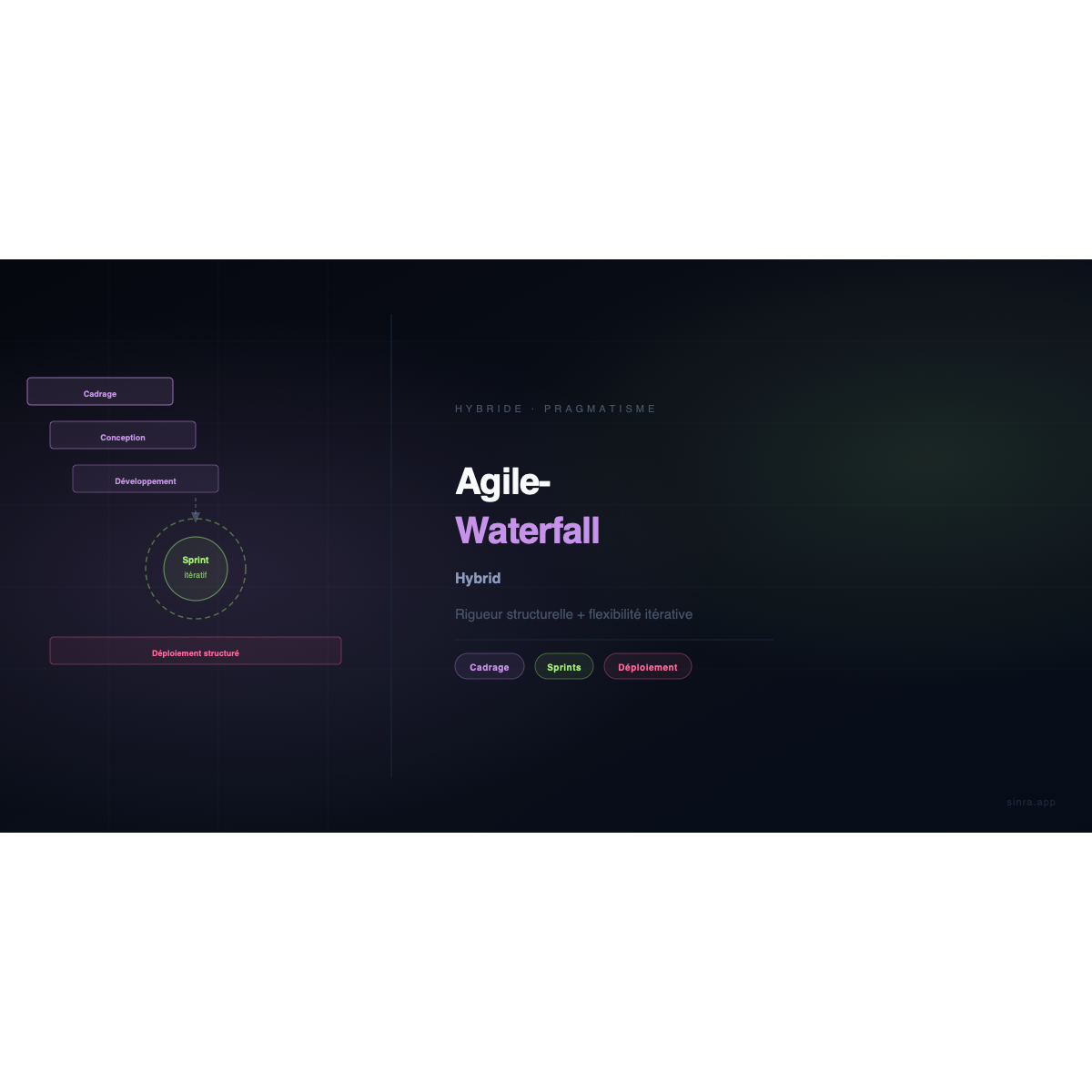
Agile-Waterfall Hybrid: How to Combine Both Models in Project Management
How to combine Waterfall's rigor with Agile's flexibility to meet real business constraints
Why a Hybrid Model?
The “Agile vs Waterfall” debate is often presented as a binary choice. In reality, most organizations operate on a continuum between the two. The Agile-Waterfall hybrid model recognizes this reality and makes it a strength.
Reasons not to go purely Agile:
- Contractual constraints fix scope and budget
- Regulatory requirements demand exhaustive documentation
- Dependencies with non-agile teams
- Large projects needing structured coordination
Reasons not to stay purely Waterfall:
- The market changes too fast to plan 18 months ahead
- Real needs emerge through use, not specifications
- Development teams are trained in agile practices
- Competition delivers faster with iterative approaches
The hybrid model finds the equilibrium adapted to each organization’s specific context.
Different Types of Hybrids
There’s no single hybrid model. Several variants exist:
Sequential-Iterative Hybrid The project is divided into Waterfall phases (framing, architecture, deployment), but the development phase uses Agile sprints. Essentially Water-Scrum-Fall, structured and acknowledged.
Component-Based Hybrid Some system parts use Waterfall (stable components, well-defined, regulated) and others use Agile (user interface, evolving business features).
Maturity Phase Hybrid A product starts in pure Agile during exploration and validation. Once stabilized and scaled, it gradually transitions to a more Waterfall model for maintenance and evolution.
Team-Based Hybrid Product teams work Agile, infrastructure and security teams work Waterfall, with defined interfaces between the two.
The Agile Manifesto and Hybrids
Recall what the 2001 Agile Manifesto says: it values individuals, working software, collaboration, and adaptation. But it also states: “items on the right have value” (documentation, contracts, plans). The Manifesto itself isn’t against Waterfall; it argues that left-side values should take priority over right-side values.
A well-designed hybrid approach respects the spirit of the Agile Manifesto: plans and documentation exist but aren’t ends in themselves.
Designing Your Hybrid Model
To design a hybrid model suited to your context, ask these key questions:
What parts of the project need predictability?
- Contractual budget and deadlines
- Regulatory compliance
- System-structuring architecture
What parts benefit from iteration?
- User features
- UX/UI
- External integrations
What synchronization points are necessary?
- Phase reviews for Waterfall milestones
- Sprint demos for Agile parts
- Integration meetings between the two approaches’ teams
Hybrid Model Strengths
Adaptability: each organization can calibrate the Agile/Waterfall slider according to real constraints.
Organizational acceptance: teams used to Waterfall aren’t traumatized, Agile teams aren’t constrained.
Risk management: the Waterfall part structures critical milestones, the Agile part absorbs detail uncertainty.
Contractual compatibility: fixed-price contracts can coexist with agile sprints in execution.
Pitfalls to Avoid
The worst of both worlds: taking Waterfall’s rigidity AND Scrum’s overhead without benefits of either.
Ill-defined interface: if the Agile and Waterfall parts don’t communicate well, chronic blockages appear.
Cultural resistance: forcing a Waterfall team to adopt sprints without training creates ineffective pseudo-Agile.
Hybrid and Sinra
Sinra is designed to work in hybrid contexts. Releases allow Waterfall planning of major deliverables. Cycles enable Agile execution. Capabilities connect strategic objectives (Waterfall) to operational tasks (Agile).
This flexibility makes Sinra naturally suited to transitional or hybrid organizations.
Sinra projects embody precisely the Waterfall side of hybrid: a Gantt view of planned capabilities defined during framing, permanently available to decision-makers, without constraining the agile execution that cycles manage.
Conclusion
The Agile-Waterfall hybrid model isn’t a crippled compromise. It’s mature recognition that different project parts have different needs. The real competence isn’t choosing between Agile and Waterfall; it’s knowing intelligently when to apply one, the other, or both.
Ready to Transform Your Project Management?
Apply these insights with Sinra - the unified platform for modern teams.
Start Free Trial